Foldables remain one of the most ambitious yet problematic frontiers in modern mobile electronics. The pursuit of an ultra-slim chassis inevitably collides with the laws of physics and the uncompromising demands of material durability. While the new Google Pixel 11 Pro Fold demonstrates measurable progress in structural integrity, it retains the critical vulnerabilities of its predecessors. An analysis of its physical resilience exposes systemic flaws in the company's engineering philosophy.
Stress and abrasion tests have evolved into a form of "digital sacrifice" for modern flagships, stripping away marketing promises to reveal a device's true structural integrity. In the case of the Google Pixel 11 Pro Fold, the results are ambivalent: while the device has become safer, it has not yet become truly reliable. Whereas the previous generation of Google's foldables was prone to catastrophic failures—including battery smoking under critical stress—the new model has, at the very least, avoided such scenarios.
An analysis of the chassis materials reveals a stark disconnect between marketing rhetoric and reality. The outer display, protected by a ceramic coating, delivered a respectable performance, withstanding a Mohs scale hardness tester up to level 6. However, deep gouges appeared at level 7, marking the absolute limit of the glass's capabilities. The situation with the internal display is far more concerning: the flexible panel succumbed as early as level 2 on the Mohs scale, with even simple fingernail scratches leaving visible marks. This underscores the fundamental challenge facing all foldable devices—the necessity of using soft polymers, which are catastrophically inferior in hardness compared to traditional tempered glass.
The choice of materials for the rear panel proved equally contentious. The touted "glass-composite fiber" turned out, in practice, to be standard high-strength plastic, which is susceptible to mechanical damage and easily scratched even by a simple knife.
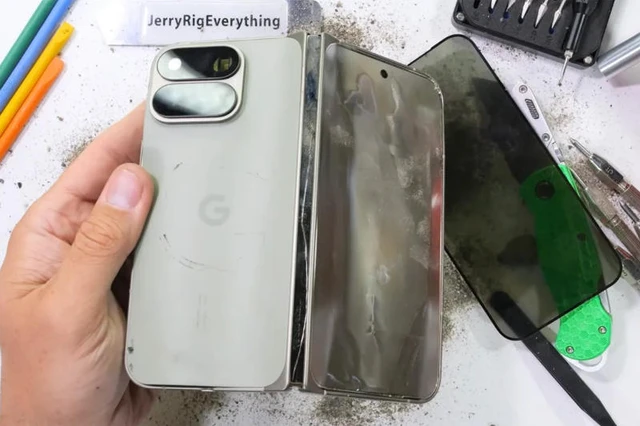
The most critical juncture of the testing was the reverse-bend test. Despite general efforts to reinforce the construction, the Google Pixel 11 Pro Fold repeated the fate of its predecessors, failing precisely along the antenna line. This recurring failure points to a systemic design flaw in the chassis: a specific point in the frame remains a "weak link" where material stress peaks. Ultimately, the device was literally torn apart without the use of specialized tools—the front panel detached on its own, and the back was ripped away with startling ease.
This outcome raises serious questions regarding the viability of Google's current design iteration. When a device repeatedly demonstrates the same structural deficiencies, it becomes evident that cosmetic refinements are insufficient. Creating a truly durable foldable requires a fundamental rethink of load distribution within the chassis, ensuring that this innovative form factor ceases to be synonymous with fragility.
 The Evolution of Apple's Augmented Reality Ecosystem