The modern race to conquer the Moon demands more than mere ambition; it requires an impeccable technical foundation. Plagued by a severe infrastructure crisis at its own Florida facilities, Blue Origin has been compelled to explore alternative avenues for system validation. In this landscape, NASA transcends the role of a mere client, acting instead as a strategic partner granting access to the agency’s storied legacy assets. Relocating these trials to the legendary B-2 test stand has become a critical maneuver to sustain the momentum of the Artemis program.
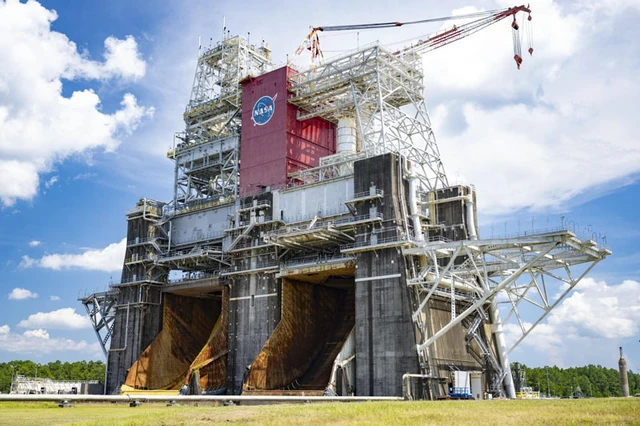
The road to operationalizing the New Glenn super-heavy lift vehicle has been fraught with significant hurdles. A recent incident at Blue Origin's Florida launch complex—where a fully fueled rocket exploded—resulted in extensive infrastructure damage. Given the aggressive timelines of current lunar ambitions, rebuilding the site from scratch could have triggered critical delays across the entire lunar program. The solution emerged as a pragmatic alliance: NASA has granted its commercial partner access to test stand B-2 at the John Stennis Space Center in Mississippi.
This collaboration is formalized via an amendment to a Space Act agreement, which allows private enterprises to utilize government infrastructure on a commercial basis. Full-scale hot-fire testing is expected to commence in autumn 2026. In the short term, B-2 will serve as the primary proving ground for the New Glenn second stage, alleviating pressure on launch complex LC-36 and allowing it to be used exclusively for its intended purpose: launches, rather than protracted ground tests.
The technical challenge lies in validating the performance of the second stage, which is powered by two BE-3U vacuum engines. These powerplants rely on a classic yet volatile cryogenic propellant combination—liquid oxygen and liquid hydrogen. Each engine generates approximately 890 kN of thrust and is engineered for multiple restarts in the deep vacuum of space. Testing at B-2 will allow engineers to validate the entire system holistically, from tank and plumbing interactions to avionics and control systems, simulating actual flight conditions with maximum fidelity.
The selection of test stand B-2 was strategic. Unlike the adjacent B-1 complex, which is designed for individual engine tests, B-2 is capable of handling fully assembled rocket stages. The facility carries immense historical weight; built in the 1960s, it served as the cradle for the legendary Saturn V stages that first delivered humans to the Moon. More recently, it hosted the final ground certifications for the SLS core stage prior to the Artemis I mission. In a very real sense, New Glenn is standing on the shoulders of giants.
Beyond physical infrastructure, NASA is providing Blue Origin with access to its deep institutional expertise in cryogenic systems and the manufacturing capabilities required to modernize the stand. This synergy is vital given New Glenn's ambitious payload targets: the rocket is designed to deliver up to 45 metric tons to Low Earth Orbit (LEO) and over 13 tons to Geostationary Transfer Orbit (GTO).
The strategic importance of these tests extends beyond a single company. Under the Artemis program, a complex docking sequence between the Orion spacecraft and lunar landers from both SpaceX and Blue Origin is slated for 2027 (the Artemis III mission). A full-scale crewed landing on the lunar South Pole is targeted for 2028 as part of Artemis IV.
New Glenn is positioned to be the primary logistical backbone for delivering Blue Moon automated cargo modules, including the Mark 1 Endurance version destined for the Shackleton crater to deploy scientific instrumentation. The success of the second-stage trials at B-2 will ensure that the technological foundation for the crewed Blue Moon Mark 2 complex is established on time and without catastrophic failure.
 BepiColombo’s Odyssey: At the Threshold of the Sun