The quest to uncover the fundamental laws of the universe demands instruments of unparalleled precision and power. The Large Hadron Collider, the crowning achievement of modern engineering, is now entering its most ambitious phase of transformation. A four-year technical hiatus will herald the transition to the High-Luminosity era, an evolution designed to push the boundaries of particle physics to their absolute limits. This is far more than routine maintenance; it is a comprehensive overhaul of the most powerful accelerator in human history.
On June 29, 2026, CERN will mark the conclusion of its current experimental cycle. The facility will enter "Long Shutdown 3"—a prolonged technical hiatus lasting until 2030. This period is set to be the most extensive transformation of the accelerator complex since its inception. The scale of the upcoming modifications is so profound that the installation will effectively be rebranded, evolving into the High-Luminosity LHC (HL-LHC).
Over the past 15 years, the LHC has cemented its position as the preeminent instrument in high-energy physics. From its initial startup in 2008 and the first proton collisions in 2009, the facility evolved from an ambitious venture into a triumph of science with the 2012 discovery of the Higgs boson. The detection of this particle provided the key to understanding how matter in the universe acquires mass, effectively closing a pivotal chapter of the Standard Model of physics.
The statistics of its achievements are staggering: the ATLAS and CMS collaborations have recorded approximately 54 quadrillion proton collisions and around 300 billion heavy-ion collisions. This data served as the foundation for over 4,500 peer-reviewed scientific publications and led to the discovery of more than 85 new hadrons. However, to probe the frontiers of the unknown and detect rarer physical phenomena, the current beam intensity has reached its limit.
The crux of the upcoming modernization lies in a radical increase in "luminosity"—the parameter that determines the number of particle collisions per unit of time. To achieve this, engineers must undertake a herculean operation to dismantle and replace approximately 1.2 kilometers of magnets and associated components within the 27-kilometer ring.
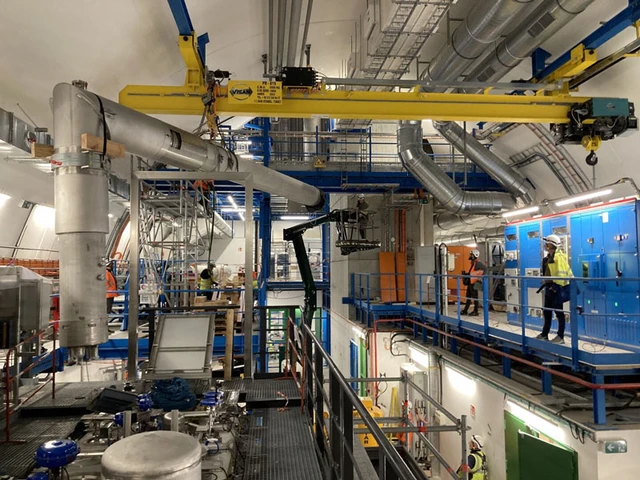
The upgrade will target critical infrastructure: cryogenic systems will be modernized, new beam-focusing optics will be installed, and cutting-edge sensors will be integrated. Simultaneously, new tunnels will be constructed to allow for the integration of additional experiments into the complex.
By 2030, when the High-Luminosity LHC comes back online, the collision event intensity will increase roughly tenfold compared to the original design. This will trigger an exponential surge in the volume of generated data. While the collider has collected one exabyte of information (a million terabytes) over the last decade and a half, this dataset is expected to grow by an order of magnitude by the mid-2030s.
This data deluge presents formidable challenges in Big Data storage and processing, but in return, it promises unparalleled precision in studying the properties of the Higgs boson. It is through the detailed analysis of this field that physicists hope to determine whether other, as-yet-undiscovered particles exist and what truly defines the fundamental architecture of our universe.
 Drones for Cloud Cover Management Over Solar Power Plants