For decades, humanity has sought to harness the power of the stars in a quest to permanently resolve the global energy crisis. While nuclear fusion promises a virtually inexhaustible source of clean energy, the road to commercial viability remains one of the most formidable challenges in modern science. Against this backdrop, American Fusion’s Texatron project has announced its transition into a critical phase of independent verification. The success of these trials could redefine our understanding of compact power plants and accelerate the dawn of the aneutronic energy era.
At the heart of Texatron's ambitions lies the concept of aneutronic fusion—a frontier with the potential to bypass the fundamental shortcomings of conventional reactors. Unlike standard reactions, where a significant portion of energy is lost as high-energy neutrons that trigger the radioactive degradation of the reactor vessel, aneutronic reactions release energy primarily in the form of charged particles. This paves the way for the direct conversion of plasma's kinetic energy into electrical current, eliminating the need for cumbersome and inefficient steam-turbine cycles.
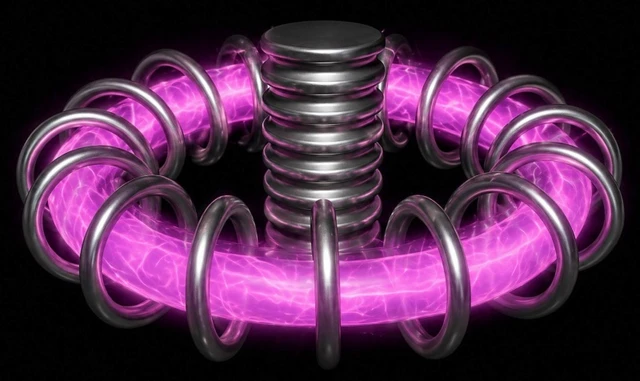
Unveiled at the 2026 IEEE International Conference on Plasma Science (ICOPS), the 5 MW Texatron platform is designed to demonstrate the viability of this approach in a pre-production iteration. The device's technical foundation relies on a specialized plasma confinement geometry. According to patent application No. 19/710,441, the reactor housing consists of a hollow toroidal chamber featuring a ribbed interior surface. This configuration is optimized for pulsed electrical energy delivery, which is critical for achieving ignition conditions and maintaining stable plasma confinement within a compact volume.
The verification process for Texatron extends beyond internal testing, involving a rigorous audit by the external scientific community. The testing protocol focuses on two fundamental parameters: plasma density and temperature. The balance between these two factors determines whether the reaction will transition into a self-sustaining fusion regime. To analyze plasma composition in real time, optical spectroscopy will be employed, with data accuracy ensured by the pre-calibration of the entire diagnostic suite against international standards.
Particular emphasis has been placed on monitoring neutron radiation. Despite the aneutronic nature of the primary process, side reactions are inevitable; therefore, confirming a minimal radiation background will serve as one of the primary proofs of the technology's efficiency. This commitment to transparency is underscored by the project's willingness to engage independent physicists and engineers to observe key launch phases, as well as the publication of detailed technical reports and video documentation.
In a global context, commercial nuclear fusion remains the "Holy Grail" of modern engineering. Despite massive investments from state laboratories and private capital, the world has yet to see an industrial-scale power plant operating on this principle. Texatron seeks to bridge this gap by offering a more compact and technologically advanced path to energy generation. Should independent tests validate the claimed specifications, it could signal a definitive transition from theoretical models and laboratory experiments to the construction of the energy infrastructure of the future.
 Drones for Cloud Cover Management Over Solar Power Plants