The exploration of the Red Planet has evolved into a rigorous test of autonomous endurance. The Perseverance rover has officially surpassed a milestone equivalent to an Olympic marathon, traversing 42.2 kilometers across the unforgiving Martian terrain. This achievement transcends a simple technical record; it serves as a definitive testament to the resilience and reliability of modern robotic systems operating in the most extreme environments. This odyssey through Jezero Crater heralds a new chapter in the quest to uncover biosignatures of primordial life beyond Earth.
On June 14, 2026, the Perseverance mission marked a historic milestone: the robotic explorer officially surpassed the 42.2-kilometer mark. Since its 2021 touchdown on the floor of the ancient lake in Jezero Crater, the rover has spent five years and four months in constant motion, evolving from a mere probe into a true planetary pioneer. The final stretch of this "Martian marathon" was captured from orbit by the Mars Reconnaissance Orbiter, providing scientists with a rare, global-scale perspective of the rover's journey.
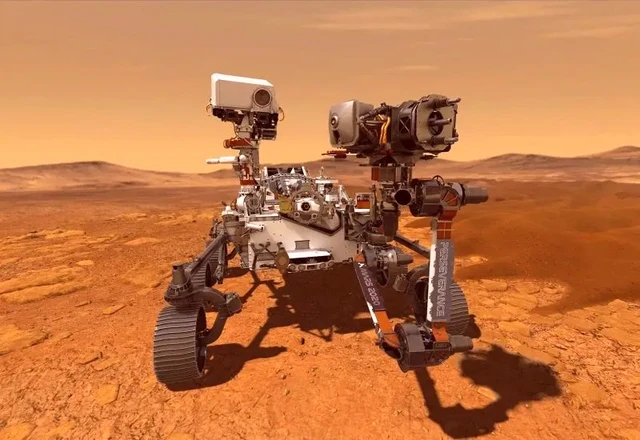
This orbital vantage point allows researchers to reassess the traversed terrain and the vehicle's structural integrity, complementing the detailed self-portraits Perseverance captures via its arm-mounted camera. One such image, meticulously stitched from 61 individual frames, showcases the staggering engineering sophistication required to operate amidst relentless dust storms and extreme thermal fluctuations.
However, the mission's true legacy lies not in the kilometers logged, but in the data harvested every meter of the way. Perseverance has effectively transformed the Martian surface into a sprawling laboratory. Utilizing its ground-penetrating radar, the rover conducted 78 high-resolution scans over a 6.1 km stretch, peering up to 35 meters beneath the regolith. This effort yielded a geological paradigm shift: the discovery of an ancient river delta hidden deep underground.
From a scientific standpoint, river deltas serve as ideal natural repositories for organic compounds, making them primary targets in the search for biosignatures. It is here that Perseverance achieved its most significant triumph. The analysis of soil samples has provided some of the most compelling evidence to date that, billions of years ago, Mars possessed a climate comparable to Earth's—creating the essential conditions for the emergence and evolution of organic life.
A comparative analysis with previous missions highlights a staggering technological evolution. The former record-holder, the Opportunity rover, also completed a marathon distance, but that feat required over 11 years of operation. Perseverance has slashed that timeframe by more than half, testifying to qualitative leaps in power systems, autonomous navigation, and the mechanical resilience of its drive trains.
Now that the 42.2-kilometer threshold is behind it, operational horizons are expanding. Given the current pace and the health of its systems, it is highly probable that Perseverance will become the first spacecraft to conquer a 100-kilometer "ultramarathon," continuing to unlock the primordial secrets of the Solar System's formation.
 Taiwan's Space Program: The First Major Milestone