The global AI arms race has long since evolved beyond the confines of standard financial reporting. While the market scrutinizes officially declared capital expenditures, the true scale of investment remains obscured within the depths of off-balance sheet liabilities. We are witnessing commitments totaling trillions of dollars pledged by tech giants over the coming decades—a strategy that transforms the trajectory of AI development into a high-stakes financial gamble.
The current technological surge is typically measured through the lens of capital expenditure (CapEx), yet corporate financial disclosures have ceased to reflect the true cost of progress. While the leading players in the U.S. tech sector reported traditional spending reaching $600 billion over the last fiscal year, the actual volume of resources deployed toward AI development is three times higher. A vast portion of these funds has shifted into "hidden" liabilities—obligations that bypass primary balance sheets but exert colossal financial pressure on these firms.
This process is driven by sophisticated financing and leasing mechanisms. Rather than direct procurement of hardware and construction of facilities, industry giants are increasingly pivoting toward long-term compute-capacity leases and credit obligations. This allows companies to scale their infrastructure without bloating their current debt reports. Often, the ownership structures are convoluted: data centers may be owned by third-party entities that raise capital through bond issuances. In such a scheme, the operator—Meta, for instance—does not record financial guarantees on its balance sheet until the facility is commissioned and regular lease payments commence. By mid-year, Meta's obligations of this nature had reached a staggering $347 billion.
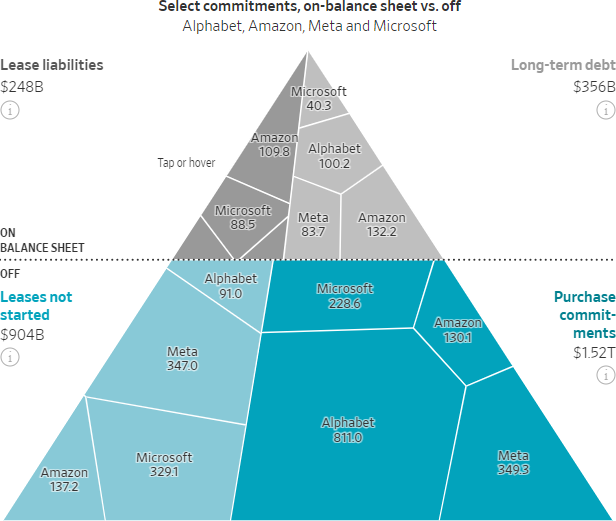
Alphabet’s strategy warrants particular scrutiny. In the company that owns Google, off-balance sheet liabilities surged more than eightfold over the year, while official CapEx grew only twofold. Alphabet's total off-balance sheet obligations have hit $811 billion, encompassing not only server capacity but also the critical power infrastructure required to sustain it. Notably, the payment horizon for these contracts extends as far as 2054, creating an illusion of long-term stability—even as the growth trajectory remains alarming: just three months ago, this figure was nearly two and a half times lower.
On an industry-wide scale, the eight largest U.S. tech corporations have accumulated $1.2 trillion in off-balance sheet liabilities. When combined with long-term loans and contracts, total "invisible" expenditures cross the $3 trillion threshold. Beyond physical infrastructure, these funds are also being channeled into strategic equity investments in other players. Nvidia, for example, plans to allocate up to $27 billion toward share acquisitions through early 2027.
However, such aggressive expansionism harbors significant systemic risks. Alphabet and Amazon have already encountered scenarios where capital expenditures began to outpace operating income, resulting in negative free cash flow. Should the monetization of AI services fail to meet inflated expectations, these companies face the threat of "stranded assets"—costly data centers that generate no profit yet demand debt servicing. In the worst-case scenario, the industry could fall into a debt spiral, where new loans are secured solely to service old obligations—a prospect already fueling growing anxiety among institutional investors.

 Anthropic’s Strategic Push for Hardware Independence