The evolution of autonomous driving systems inevitably pits technological optimism against the stark realities of road safety. In China, this tension has escalated into a sweeping regulatory crackdown impacting millions of Tesla vehicles. At the heart of the issue lies the inadequacy of driver monitoring systems, which have proven alarmingly susceptible to simple bypasses. Consequently, software-based remediation has become the sole means of restoring the equilibrium between the convenience of automation and the imperatives of safety.
For years, Tesla’s approach to driver attentiveness relied heavily on haptic feedback. The system depended on steering wheel torque sensors: electronics detected resistance during rotation as a proxy for the driver's presence. However, this architecture proved ripe for exploitation. As Autopilot capabilities expanded, a market emerged for third-party devices designed to simulate touch, while social media became flooded with clips of owners letting their cars drive themselves while they lounged in the passenger seat.
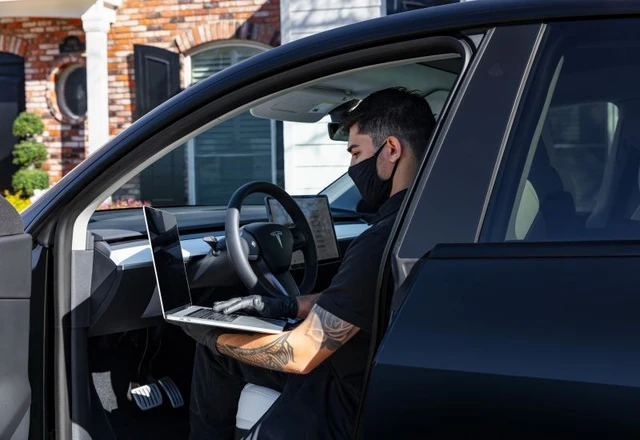
The hardware foundation for more rigorous oversight had been present for some time. In-cabin cameras became standard for the Model 3 as early as 2017, later appearing in the Model Y and being integrated into the refreshed Model S and Model X by early 2021. Despite the available hardware, the full-scale deployment of video analytics for driver monitoring only began in the US in May 2021. Tesla emphasized that the camera did not record footage but merely analyzed eye positioning in real-time. Yet, even this method proved flawed; in China, instances emerged where the system was successfully deceived by plastic mannequins.
The response from Chinese regulators was swift and systemic. A massive recall has impacted nearly 2.8 million Model 3 and Model Y vehicles produced at the Shanghai plant between March 2019 and the end of 2025. The primary grievance from authorities is that current monitoring measures are insufficient for SAE Level 2 driving assistants. Regulators are demanding the implementation of more sophisticated gaze-tracking algorithms to ensure drivers remain focused on the road.
The situation is further complicated by the launch of Tesla Assisted Driving in China—the local equivalent of FSD—which opened new loopholes for bypassing the automation. User experiences revealed that a stationary mannequin could simulate a present driver for up to half an hour, effectively leaving the vehicle unsupervised. Tesla had previously attempted to limit the use of the cabin camera in the region, citing local legislative nuances, but safety imperatives have now overridden these legal concerns.
The fix will be deployed via an Over-the-Air (OTA) software update, sparing owners a trip to the service center. Nevertheless, this case highlights the mounting pressure on developers of autonomous systems. When coupled with a parallel campaign to fix emergency door-opening mechanisms, the total number of affected vehicles in China reaches a staggering 5.7 million units. This marks a pivotal industry shift: the era of "public beta testing" is giving way to an era of stringent state oversight regarding algorithmic safety.
 Anthropic’s Strategic Push for Hardware Independence