The era of conventional LCD panels is rapidly receding, making way for OLED technology—a shift that is fundamentally redefining the benchmarks of visual experience. The global display market is currently undergoing a period of aggressive expansion, propelling OLED from a boutique luxury into the new industry gold standard for both hardcore gamers and creative professionals. Trends from recent quarters reveal more than just a surge in volume; they signal a fundamental qualitative shift in consumer preferences. At the heart of this evolution are the tech titans, locked in a fierce battle for supremacy within the premium segment.
The display industry has entered a phase of aggressive expansion. According to current market data, the second quarter of 2026 has seen an unprecedented surge in OLED monitor shipments. Year-over-year growth has soared by nearly 100%, with sequential quarterly growth exceeding 26%. This sharp spike is driven by a synergy of several factors: the launch of new technological product lines, aggressive marketing strategies, and a powerful impulse from the Chinese consumer market, where the "618" shopping festival acted as a catalyst for mass demand.
A primary driver of this trend has been the consolidation of 27-inch QHD panels as the dominant form factor. This specification has emerged as the "gold standard," providing an optimal balance between image detail and graphical system performance, making it highly attractive to a broad spectrum of users.
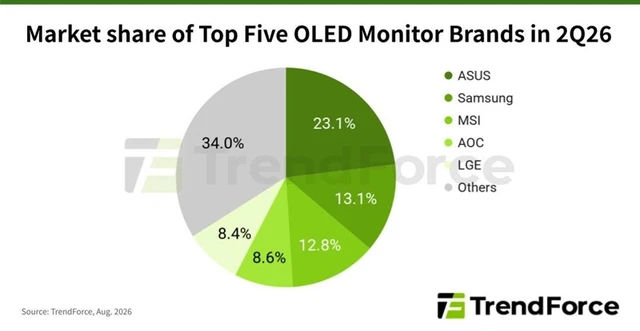
In the hierarchy of manufacturers, Asus maintains its lead with a market share of 23.1%. The company's success is rooted not only in general market trends but also in its deep penetration into specific niches—most notably the Chinese internet cafe segment, where requirements for image quality and response times are exceptionally stringent.
The landscape for other market players appears more volatile. Samsung, long a dominant force, is experiencing a gradual erosion of its influence in the Chinese market, with its share slipping to 13.1%. Meanwhile, MSI has nearly closed the gap with the Korean giant, reaching a share of 12.8%. This growth was made possible through precision-engineered advertising campaigns and the strategic leveraging of peak consumer demand periods.
Rounding out the top five are AOC and LG. The former focused on the mass production of models within the high-demand 27-inch QHD segment, securing an 8.6% market share. In contrast, LG has pivoted toward the ultra-premium segment, scaling sales of 39-inch WUHD monitors, which earned the company a share of 8.4%.
The overarching trend points toward the gradual democratization of the technology. The optimization of panel supply chains has allowed emerging brands to close the gap with technological leaders. This suggests that OLED is no longer the exclusive privilege of flagship lineups but is becoming an accessible tool for a wider array of manufacturers—a shift that will ultimately lead to fiercer competition and further advancements in display quality.
 The Price of Acceleration: CXMT’s Rapid Push into Memory