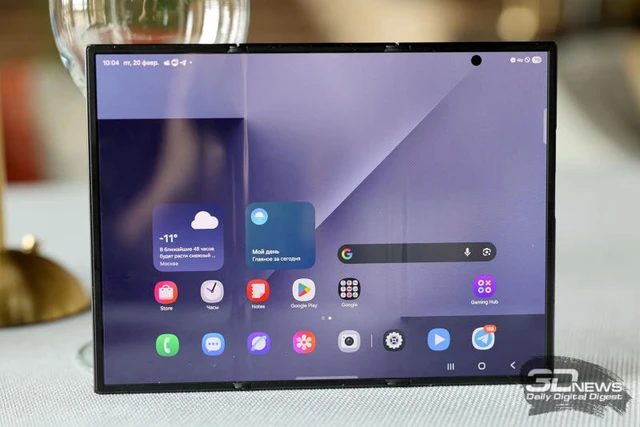
The market for foldable devices has decisively evolved from a playground for technological experimentation into a mature, mass-market segment. Nevertheless, the "crease"—the lingering mark of mechanical stress that gradually manifests on OLED panels—remains the primary aesthetic and technical pain point. Samsung Display aims to resolve this by fundamentally re-engineering the properties of its protective coatings. This new approach hinges on manipulating the physical parameters of the glass to achieve an optimal synergy between structural rigidity and flexibility.
The crease in foldable smartphones is, fundamentally, a challenge of materials science. Current devices rely on Ultra Thin Glass (UTG), which must simultaneously be hard enough to resist scratches and plastic enough to endure hundreds of thousands of folding cycles. Until now, the industry has pursued a strategy of uniform thinning across the entire glass sheet, but this approach creates an inherent compromise: glass that is too thick results in a deep central crease, while glass that is too thin loses structural integrity and becomes overly vulnerable.
Samsung Display’s new strategy, dubbed Center Etched Thin Glass (CTG), moves away from the concept of uniformity. Rather than thinning the entire layer equally, engineers are implementing variable thickness. Along the central axis—the point of maximum curvature—the glass undergoes selective etching to achieve minimum thickness. Meanwhile, the surrounding areas of the display maintain a greater thickness, providing the necessary rigidity and protecting the matrix from external impacts.
From a materials physics perspective, this solution radically reduces internal stress at the peak of the bend. By thinning the central section, the bend radius becomes more natural, significantly slowing material degradation and preventing the formation of deep, visible grooves. Consequently, the device not only gains aesthetic appeal but also becomes potentially thinner and more resilient to mechanical wear.
However, shifting from a uniform layer to a variable one introduces a new engineering hurdle: the risk of perceptible height variances across the screen's surface. To ensure users do not feel the boundary between the "thin" and "thick" zones, Samsung is developing specialized polymer fillers. These compounds are designed to neutralize the difference in glass thickness, creating a visually and tactually flawless plane.
The implementation of CTG technology could be a pivotal moment for the entire flexible panel industry. If Samsung succeeds in achieving a seamless transition between these zones of varying thickness, it will enable a generation of devices where the screen feels like classic tempered glass, while finally eliminating the primary flaw of the foldable form factor: the visual defect at the center of the display.
 Meta’s New Era of Visual Interaction