The pursuit of the ideal display has long been a war of attrition against the laws of physics and the inevitable chemical degradation of materials. High pixel density inherently conflicts with brightness and longevity, creating a persistent engineering bottleneck for professional-grade monitors. LG Display aims to break this deadlock by fundamentally reimagining the internal architecture of organic panels. The transition toward multi-layer emissive structures may prove pivotal in unlocking the next generation of hardware, potentially paving the way for future iterations of the iMac.
In the display industry, there is a fundamental tension between pixel density (PPI) and panel longevity. As individual pixels shrink to achieve ultra-high resolutions, the actual surface area of the light-emitting element decreases accordingly. To maintain standard brightness levels across a smaller area, manufacturers must increase the load on organic materials, which inevitably accelerates degradation and heightens the risk of "burn-in"—the appearance of permanent ghost images on the screen.
The solution to this challenge lies in a transition toward multi-layered architectures. LG Display is developing innovative five-layer OLED panels featuring a BGBRB configuration. In this setup, three blue (B) emitting layers are utilized alongside one red (R) and one green (G). While the company previously experimented with a four-layer BGBR scheme (two blue layers), the five-layer approach allows for the most efficient distribution of electrical load. Since blue organic LEDs traditionally suffer from the shortest lifespan and lowest efficiency, increasing their count to three layers enables high brightness without inducing critical material wear.
The technological viability of this approach has already been demonstrated in practice. LG unveiled a 27-inch 5K panel (5120 × 2880 pixels) with a density of 220 PPI, built on a four-layer structure. A key highlight here is the implementation of an RGB Stripe layout. Unlike standard arrangements where subpixels may be positioned haphazardly or in pentagonal patterns, this linear alignment of red, green, and blue elements ensures exceptional clarity for fine text and graphical primitives—a critical requirement for professional content creation.
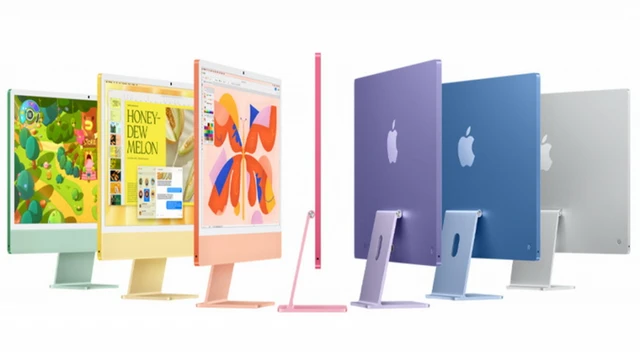
This development aligns directly with the requirements of the market's biggest players. It is well-known that Apple previously issued a Request for Information (RFI) to manufacturers regarding OLED panels for its iMac desktops. The specifications were stringent: a 24-inch diagonal, brightness of 600 nits, and a pixel density of approximately 218 PPI. LG Display's current prototypes not only meet these benchmarks but exceed them in terms of pixel density. While these panels remain research samples used to evaluate mass-production readiness, they set the trajectory for the entire premium monitor category.
However, the path to commercialization is complicated by economic headwinds. Increasing the number of emitting layers leads to higher consumption of costly organic materials and complicates the deposition process. Consequently, producing five-layer panels is significantly more expensive than traditional manufacturing methods.
Amidst these developments, a fierce competitive battle is unfolding: Samsung Display is betting on Quantum Dot OLED (QD-OLED) technology, which also vies for a spot in future iMacs. Both companies aim to finalize the development of their flagship solutions by 2028, meaning consumers could see these technologies integrated into retail products as early as 2029.
 The Price of Acceleration: CXMT’s Rapid Push into Memory