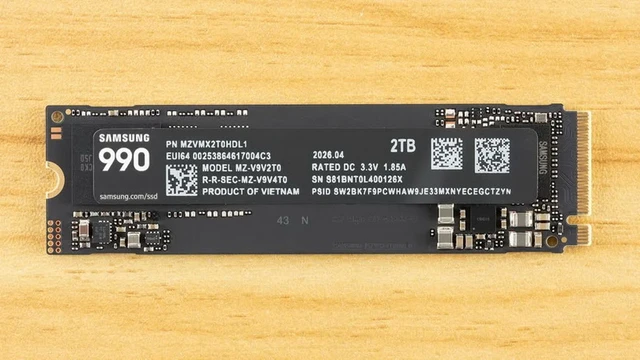
The contemporary SSD market is defined by a delicate balancing act between storage density and manufacturing costs. The new Samsung 990 lineup serves as a quintessential case study of this dynamic, where engineering trade-offs collide with market expectations. Despite being positioned as a value-driven alternative, its pricing remains contentious when weighed against the actual specifications provided. At the heart of the discussion is the transition to multi-layer QLC NAND and the deliberate omission of traditional hardware buffers.
The launch of the new Samsung 990 NVMe PCIe 4.0 series highlights a distinct paradox within the modern memory industry. On one hand, the company is implementing cost-optimization strategies; on the other, it maintains a premium price point that is hardly accessible to the average consumer. With the 1TB and 2TB models priced at $270 and $530 respectively, there is a palpable dissonance between the product's technical essence and its market positioning.
The architectural backbone of the Samsung 990 series is the Piccolo-Q controller, operating in a DRAM-less configuration. The absence of dedicated DRAM cache is offset by the integration of cutting-edge 280-layer 3D QLC NAND V9 flash memory. It is crucial to distinguish this lineup from the Samsung 990 EVO: while the latter utilizes more durable TLC (Three-Level Cell) memory, these new models have transitioned to QLC (Quad-Level Cell). By storing four bits of data per cell instead of three, Samsung increases storage density within the same physical footprint—though this inevitably results in reduced write endurance and a performance dip once the SLC cache is exhausted.
Performance remains high, consistent with the capabilities of the PCIe 4.0 interface. The 1TB variant delivers sequential read speeds up to 7,150 MB/s and write speeds up to 6,450 MB/s. In random access operations, it reaches 700,000 IOPS for reads and 1.1 million IOPS for writes. The flagship 2TB model pushes these figures even further: read speeds climb to 7,250 MB/s, while random read performance hits 850,000 IOPS with write operations reaching 1.2 million IOPS.
However, beneath these blistering speeds lies the primary compromise: drive endurance (TBW). The shift to QLC memory significantly reduces the total volume of data the device can write before cell degradation occurs. The 2TB model is rated at 800 TBW, while the 1TB version offers 400 TBW. For comparison, the more expensive and technologically advanced 990 EVO Plus, utilizing TLC memory, provides substantially higher endurance: 1,200 TBW and 600 TBW, respectively.
This reduction in lifespan is directly reflected in the warranty terms; the manufacturer provides a three-year warranty—a standard, if not generous, offering for today's premium segment. Ultimately, the Samsung 990 is a specialized tool designed for workloads requiring high read speeds for large datasets without the need for constant, intensive write cycles. It is a pragmatic product that illustrates the industry's pivot toward higher density and lower durability in the pursuit of scaling capacity.
 The Horizon of China's Technological Sovereignty in Lithography