Deep space exploration demands a level of electronic reliability that transcends terrestrial standards. In the void, ionizing radiation and extreme thermal cycling render conventional semiconductors fragile, leaving them susceptible to catastrophic failure. Intel Starfire emerges as the solution—a specialized processor engineered to synthesize high-performance modern computing with uncompromising resilience. This silicon marks a pivotal shift from rudimentary control systems toward sophisticated, fully integrated onboard AI capable of thriving in the harshest reaches of open space.
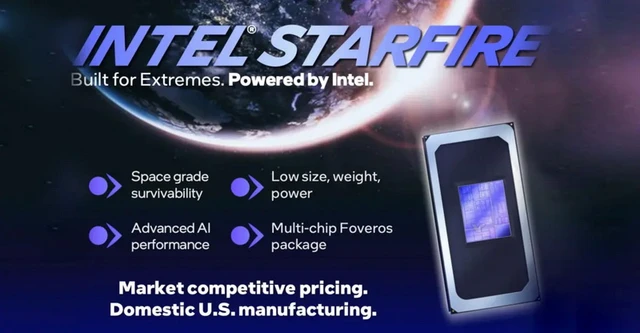
Designing computing systems for spacecraft has historically been a balancing act between raw performance and mission-critical reliability. Traditionally, the aerospace industry has relied on legacy, proven fabrication processes capable of withstanding the onslaught of ionizing radiation. Intel Starfire shatters this paradigm by leveraging advanced Foveros multi-chip packaging. This technology enables the integration of the CPU, GPU, and NPU into a single vertical structure—a critical evolution for minimizing mass and footprint while maximizing computational density.
The Starfire architectural stack is a masterclass in heterogeneity. The primary compute power is driven by four high-performance P-cores and four low-power efficiency (LPE) cores, both fabricated using the cutting-edge Intel 18A process. Working alongside them is a three-block NPU, also based on 18A, providing hardware-level acceleration for machine learning algorithms directly on board. The graphics subsystem, implemented via the Intel 3 process, features four Xe cores with 64 execution units, enabling the real-time processing of complex visual data and telemetry.
System versatility is driven by dual power profiles, allowing the chip to be tailored for everything from autonomous sensors to full-scale orbital stations. In low-power mode (10W), P-cores operate at 1.0 GHz and LPE-cores at 850 MHz, delivering an AI performance of 45 TOPS. For more resource-intensive workloads, a high-performance mode with a TDP of up to 35W is available: here, P-core clock speeds surge to 3.1 GHz, LPE-cores accelerate to 2.1 GHz, and the GPU runs at 2.0 GHz. In this state, the NPU's throughput climbs to 75 TOPS, unlocking capabilities for autonomous navigation and data analysis without relying on ground control centers.
However, the true value of Starfire lies not in its clock speeds, but in its resilience—its ability to survive where conventional silicon fails. The processor is rated for operation between −55°C and +125°C, covering the vast majority of deployment scenarios in space and the upper atmosphere. Furthermore, the system's operational lifespan is engineered with a margin exceeding ten years.
Particular emphasis has been placed on radiation hardening. The chip is currently undergoing a rigorous series of tests for Total Ionizing Dose (TID) resistance and Single Event Effects, such as Single Event Latch-up (SEL), which can trigger internal short circuits when struck by heavy charged particles.
In terms of connectivity, Starfire remains a cutting-edge tool: support for LPDDR5 and DDR5 memory, along with 12 PCIe 4.0 lanes, allows the processor to integrate seamlessly into complex data ecosystems. Manufacturing will be centralized in the United States, with initial samples expected to hit the market in the third quarter of 2026. While final specifications may be tuned following test results, Starfire already appears to be the foundation for a new generation of autonomous space systems.
 The Strategic Alliance of Nvidia and MediaTek