The global LLM arms race is shifting its focus from raw computational power toward accessibility and operational efficiency. OpenAI’s decision to temporarily lift short-term constraints on GPT-5.6 Sol underscores a systemic tension between escalating compute costs and the rigorous demands of the professional market. As AI evolves into a mission-critical productivity tool, rigid rate limits cease to be mere safeguards and instead become prohibitive bottlenecks. This move signals a strategic imperative to retain the platform's most high-value cohort: developers and enterprise teams.
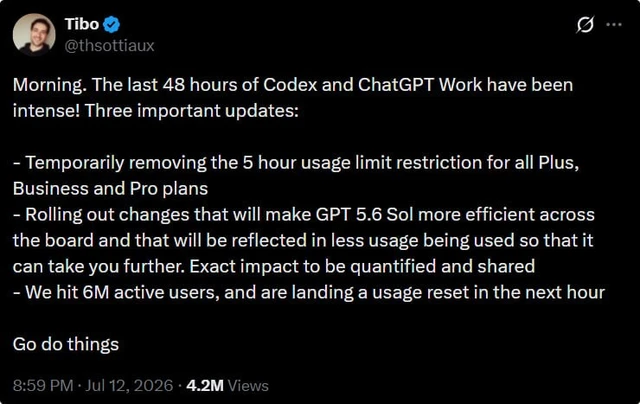
In today's generative AI ecosystem, access to computational power has become the primary lever for managing user experience. OpenAI has taken a radical step by temporarily suspending five-hour usage windows across all paid subscription tiers—Plus, Pro, and Business. Effectively, the company has reset resource consumption metrics for its clients to clear an emerging infrastructure bottleneck.
The catalyst for this decision was an unexpected surge in demand for the integration of Codex and ChatGPT Work. Within the first 48 hours of launch, usage intensity spiked so sharply that users began facing widespread lockouts. The problem was exacerbated by the underlying resource allocation logic: local queries in Codex and cloud-based tasks in ChatGPT Work drew from a single shared pool of limits. Consequently, heavy activity in one service automatically paralyzed access to the other, creating a critical friction point in the professional user's workflow.
It is crucial to understand that this measure addresses only short-term barriers. Weekly quotas remain intact, meaning OpenAI is not pivoting to a fully unlimited model, but is instead optimizing conditions for high-intensity work sessions.
Parallel to these administrative shifts, OpenAI has focused on the technical optimization of the GPT-5.6 Sol model. Engineers have achieved significant gains in computational efficiency, allowing the model to execute the same volume of tasks with fewer resources. According to internal management estimates, token efficiency has increased by approximately 54% compared to the previous generation. Data from the independent agency Artificial Analysis corroborates this trend: Sol consumes half as many tokens as Anthropic's competing Claude Fable 5. In the long term, such optimization should reclaim at least 10% of the available quota for every user.
To further refine the user experience, OpenAI is introducing the concept of "banked resets." This system will allow users to save limit resets for up to 30 days, activating them during periods of peak load. To mitigate the negative impact of previous technical glitches, the company has already implemented compensation measures for fifty thousand users who encountered malfunctions within the reset system.
These strategic moves by OpenAI cannot be viewed in isolation from the broader market context. A fierce rivalry is currently unfolding with Anthropic, which is also maneuvering around model availability by extending free access periods for Claude Fable 5. While competitors are betting on mass reach, OpenAI is focusing on professional retention—targeting an audience for whom AI has evolved from a novelty into a mission-critical production tool.
Although the current reprieve is temporary and the timeline for reinstating five-hour windows remains undefined, it is evident that the industry is gravitating toward more fluid resource consumption models. Beyond official changes, there are clear signs of A/B testing: some users report lifted restrictions on other models, suggesting a search for the optimal equilibrium between server load and customer loyalty.
 The Strategic Alliance of Nvidia and MediaTek