Modern aviation is poised for a fundamental transformation, as the demarcation between military innovation and commercial logistics rapidly dissolves. The quest to reconcile the energy density of traditional fuels with the surgical precision of electric propulsion has catalyzed the development of next-generation hybrid systems. Project Halo serves as the manifestation of this vision, translating the operational prowess of heavy combat UAVs into civilian infrastructure. It represents a strategic leap toward establishing an autonomous logistical ecosystem capable of operating seamlessly under extreme conditions.
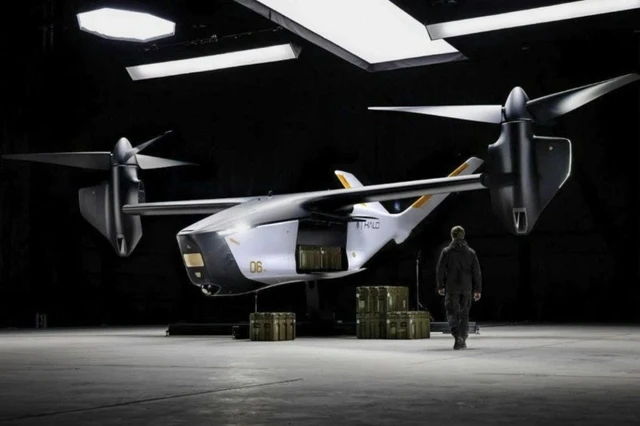
At the heart of Project Halo lies a profound strategic synergy between Archer Aviation and Anduril. The aircraft is essentially a commercial derivative of the Thunder tiltrotor, which was originally engineered as a high-tech "wingman" for combat helicopters. While the Thunder was designed for complex tactical operations in conflict zones, Halo pivots this capability toward civilian applications, ranging from supplying remote installations to critical emergency logistics.
The aircraft's engineering architecture is based on a tiltrotor configuration with two pivoting rotors. This design merges the primary advantages of both helicopters and fixed-wing aircraft: vertical takeoff and landing (VTOL) capabilities provide agility in confined spaces, while the transition to horizontal flight enables high cruise speeds. By optimizing rotor RPM according to the flight phase, the system significantly reduces energy consumption and its acoustic signature—a critical factor for operations near populated areas.
Of particular note is the series hybrid powertrain. Unlike traditional systems, the internal combustion engine has no mechanical link to the rotors; its sole function is to drive a generator that powers the electric motors and the battery system. This approach addresses the primary bottleneck of modern eVTOLs: low battery energy density. The hybrid configuration maintains the precision of electric propulsion while exponentially increasing operational range.
In terms of technical specifications, Halo falls into the heavy-class Group 5 UAS category—the most sophisticated and largest class of unmanned systems, capable of operating at altitudes up to 5,500 meters. The aircraft is expected to reach speeds of 515 km/h with an operational range of approximately 1,480 km. A key engineering triumph is the modularity of the airframe; the vehicle can be disassembled and packed into a standard shipping container, enabling rapid deployment via any transport mode, from rail platforms to cargo aircraft.
The operational paradigms for Halo extend far beyond simple parcel delivery. The primary focus is on servicing offshore oil, gas, and wind farms, where traditional helicopter logistics are prohibitively expensive and fraught with risk. In disaster zones or firefighting operations, the system's autonomy becomes the decisive factor: the ability to deliver medical supplies or heavy equipment into hazardous areas without an onboard pilot eliminates human risk entirely.
The division of labor between the developers underscores the comprehensive nature of the project. Archer Aviation has focused on the "hardware"—the airframe, electric motors, and hybrid power systems. Anduril, meanwhile, provides the intelligence, integrating a control system based on the Lattice platform—an advanced software suite for autonomous flight. To facilitate commercial scaling, Japanese firm Marubeni Aerospace has been brought on board to manage market entry and define operational use cases.
Despite their shared technological foundation, the production chains for Halo and Thunder will remain distinct. The civilian version will rely on open commercial supply chains and standardized software, whereas the military variant will remain within Anduril's closed ecosystem. Ultimately, the project serves as a blueprint for the efficient conversion of defense technology into tools for economic growth and global security.
 The Technological Leap of China's Consumer Market