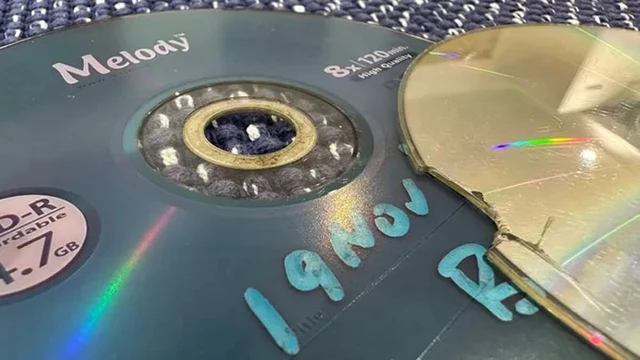
The era of physical media is fading into obsolescence, but for collectors, the battle for data preservation is only just beginning. A troubling phenomenon has recently emerged: legacy CDs and DVDs are beginning to spontaneously crack and disintegrate, even in the absence of any mechanical stress. This is not a matter of routine oxidation of the reflective layer, but rather a profound structural degradation of the polymer substrate itself. This process reveals a latent vulnerability in polycarbonate when exposed to specific chemical catalysts. Understanding the nature of this decay has become critical for the long-term archiving of our digital history.
For years, the primary concern regarding the long-term preservation of optical discs was "disc rot"—the oxidation of the reflective metallic layer or the degradation of organic dyes under UV exposure. However, recent observations, particularly within Japanese collector communities and highlighted by industry resources like Tom’s Hardware, point to a far more fundamental issue. Some discs are literally crumbling, with the substrate itself disintegrating.
At the heart of this failure is polycarbonate, a thermoplastic prized for its high transparency and mechanical strength. Yet, despite its impact resistance, polycarbonate is acutely sensitive to specific chemical agents. When exposed to aggressive substances, microscopic zones of clouding and networks of micro-cracks begin to form within the material's structure. This process triggers a sharp decline in impact strength; the material becomes brittle, and the inherent internal mechanical stresses lead to spontaneous cracking or even total structural failure.
Paradoxically, this degradation can be triggered by "excessive care." Using potent solvents such as acetone or benzene to clean a disc's surface is a fatal error, as these substances can dissolve polycarbonate at a molecular level. Even milder agents, such as isopropyl or methyl alcohol, can compromise the structural integrity of the plastic if used excessively or frequently.
There is also a more insidious factor: the chemical composition of the storage environment. Many protective cases for electronics and media are equipped with polyurethane foam inserts. Over time, this material undergoes natural aging and begins to offgas volatile organic compounds (VOCs). In a sealed, airtight environment, these gases concentrate directly against the surface of the disc.
It is hypothesized that ammonia compounds released from aging polyurethane foam act as catalysts for the chemical stress cracking of polycarbonate. While definitive confirmation requires detailed chemical analysis of specific samples, the mechanism by which volatile substances affect polymers is well-documented in materials science.
Notably, the nature of the failure varies by medium. A classic Compact Disc (CD) consists of a single monolithic layer of polycarbonate, meaning its degradation manifests as through-and-through cracks. A DVD, however, has a different architecture: it comprises two thinner polycarbonate halves bonded together. This creates a different stress dynamic, but it offers no protection against chemical attack.
Consequently, the physical preservation of data on optical media is far more precarious than previously assumed. The combination of substrate chemical decay, reflective layer oxidation, and dye degradation turns data archiving on CDs and DVDs into a genuine battle against entropy—one that demands strict environmental control and a total abandonment of aggressive cleaning methods.
 Next-Generation Ultra-Lightweight Lens Technology