The boundary between essential hardware drivers and intrusive adware is becoming increasingly porous. A recent incident involving LG monitors has laid bare a systemic crisis of trust between peripheral manufacturers, operating systems, and the end user. At the heart of the controversy lies the stealthy deployment of applications that effectively transform professional-grade tools into marketing vehicles for third-party services. This situation raises a fundamental question regarding the right of corporations to maintain silent access to user system resources.
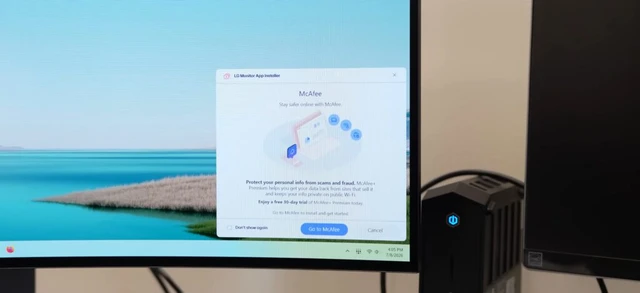
The controversy erupted following the discovery of a dubious distribution mechanism for the LG Monitor App Installer. The software was being pushed to user machines under the guise of driver updates via Windows Update, effectively bypassing the stage of informed consent. Once installed, the application began triggering pop-up advertisements offering free trials of McAfee antivirus and other products within the LG ecosystem.
The issue entered the public spotlight after a series of rigorous tests conducted by specialized tech analysts. Experiments across several Windows 11 systems confirmed that a promotional banner appeared in the corner of the screen upon every system boot. While McAfee was the primary focus, offers for LG Switch, Calibration Studio, and Dual Controller also surfaced periodically.
Microsoft’s response was swift once the incident gained significant traction. Leadership within the Windows and Devices division confirmed they had engaged with LG, resulting in an agreement to disable the McAfee pop-ups. However, this move appears to be a superficial remedy rather than a solution to the root cause.
The primary risk lies not in the pop-ups themselves, but in the delivery method of the software. The LG Monitor App Installer is deployed without an explicit request or authorization from the user. From a technical standpoint, such an installation grants the service extensive privileges: ranging from access to system resources to the collection of geolocation data, online activity logs, contacts, and user credentials. Furthermore, this practice of stealth deployment has been observed for several years, with activity appearing even on devices purchased three years ago.
This case highlights a critical vulnerability in Microsoft's policy regarding "companion apps." According to the Universal Windows Platform (UWP) developer documentation, the system allows applications to be installed automatically when a device is connected to a PC, provided the user has not modified the recommended privacy settings. Microsoft itself acknowledges in its guidelines that such functionality may be perceived by users as "confusing and unpleasant," yet it remains available to vendors.
LG is far from alone in this. Such methods of aggressive marketing via drivers and hardware management utilities have become something of an industry standard. Similar grievances have been aired against Razer, Logitech, Asus, and Gigabyte. The list of affected LG monitor models is extensive, spanning from the mass-market GN and GP series to the premium UltraGear lineups (including models 32GS95UE-B and 45GX950-B).
When viewed through the broader lens of LG's corporate ethics, a distinct pattern emerges. The company previously asserted that smart TV owners are solely responsible for granting third-party consent for voice recording—a move hinting at the use of consumer data to train AI models. Combined with the history of stealth installers, this paints a portrait of a corporation prone to expansion at the expense of client privacy.
 The Triumph of 3nm Chip Manufacturing