The demand for high-performance computing within a compact footprint has emerged as a defining trend in the contemporary workstation market. With the advent of Thunderbolt 5, the traditional divide between the portability of ultrabooks and the raw power of dedicated GPUs is rapidly evaporating. Sparkle’s latest station aims to redefine the external GPU (eGPU) paradigm, providing creative professionals with a versatile toolkit for high-end rendering and design. This device represents a pivotal milestone in the evolution of modular ecosystems tailored for content creators.
Sparkle’s trajectory represents a compelling homecoming to the consumer market. With deep roots in a partnership with Nvidia spanning 2000 to 2013, the company spent a significant period pivoting toward embedded systems. However, recent years have seen a strategic return to the mass market—first through the release of Nvidia-based external graphics solutions, and subsequently through a pivotal partnership with Intel in 2023. It is this synergy of diverse technological stacks that paved the way for the creation of the TCX-280DF Creator Station.
At the heart of the device lies the Intel Barlow Ridge controller, which enables Thunderbolt 5 support. This is a pivotal advancement; the channel's bandwidth now reaches 80 Gbps, with the potential to scale up to 120 Gbps. In the context of external GPUs (eGPUs), such data transfer speeds minimize the latency and performance degradation that have historically been the primary bottlenecks for these systems.
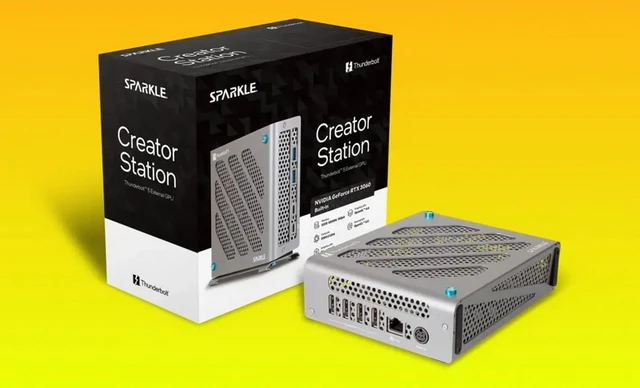
Functionally, the station transcends the role of a mere GPU enclosure, operating instead as a comprehensive high-performance hub. The Thunderbolt 5 host port supports Power Delivery up to 85W, allowing it to simultaneously charge a laptop and transmit data. A secondary 15W downstream port, four DisplayPort 1.4 outputs, two USB Type-A ports (10 Gbps), and a 2.5 Gbps Ethernet interface transform the device into a centralized command center for peripherals.
In its current iteration, the Creator Station ships with a GeForce RTX 3060 featuring 12 GB of VRAM. While this model is no longer a flagship, its VRAM capacity makes it a viable instrument for graphic design and entry-level machine learning. Furthermore, Sparkle’s roadmap suggests an expansion of the lineup: versions featuring entry-level professional accelerators, such as the Nvidia T1000 (4 GB) and RTX A2000 (8 GB), are expected. These are specifically tailored for stability within CAD environments and specialized professional software.
From an industrial design perspective, the device is remarkably minimalist. Measuring 170 × 149 × 59 mm and weighing just over one kilogram (including the vertical stand), the station maintains a negligible footprint on the workspace. Power requirements are handled by an external 280W power supply, ensuring the necessary overhead for stable GPU performance under load across Windows 10 and 11.
The product's current market positioning remains nuanced. In Japan, the device is priced at approximately $1,130, creating a noticeable price premium between the cost of the graphics chip itself and the final cost of the station. However, this pricing is justified by the integration of the cutting-edge Thunderbolt 5 standard and the delivery of a turnkey ecosystem solution, sparing the user from the complexities of assembling DIY eGPU enclosures and sourcing compatible components.
 Nvidia’s Technological Pragmatism in the Open-Model Race