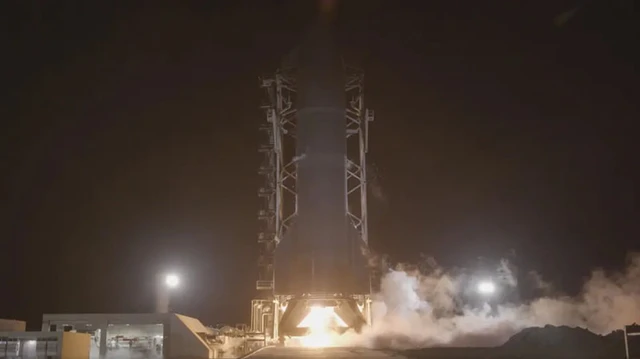
SpaceX's inclusion in the Nasdaq 100 is more than a mere financial milestone; it is a validation of the singular status of Elon Musk’s empire. Despite remaining a loss-making venture, the company is rewriting the traditional market playbook, unlocking access to the deep pockets of the world's largest institutional investors. This transition elevates the private titan into a full-fledged public market contender, poised for exponential growth. The central question now is whether the company can successfully translate its technological momentum into sustainable, long-term market value.
SpaceX's accelerated inclusion in the Nasdaq 100 is an unprecedented move. Under standard market conditions, a company reporting losses would struggle to clear the stringent filters of one of the world's most prestigious technology indices. However, the exceptional nature of Elon Musk's business model forced regulators and index operators to pivot, effectively acknowledging SpaceX as a systemically important player in the global technology sector.
The market response was immediate. Following Monday's close, with shares settling around $160, analytical agencies began issuing forecasts that are overwhelmingly optimistic. The most bullish experts at Morgan Stanley suggest that quotes could climb to $300, while Arete Research presents an even more radical scenario, seeing growth potential up to $401 per share.
The rest of the market remains more tempered, though still positive. RBC and Banco BTG Pactual estimate a fair value of $225, while UBS and Goldman Sachs hold more conservative targets of $210 and $205, respectively. Even the most cautious projections from Stifel and New Street Research remain above current levels, ranging from $175 to $190.
The fundamental catalyst for this optimism is not merely the space program, but SpaceX's strategic expansion into artificial intelligence. The company is developing an infrastructure of specialized AI servers tailored to specific client needs. This trajectory allows SpaceX to integrate into the "neocloud" ecosystem—a new generation of cloud providers focusing on high-performance computing (HPC) and GPU capacity, bypassing traditional hyperscalers through agility and specialization.
From a technical standpoint, index inclusion triggers a massive surge in liquidity. After SpaceX entered the Russell 1000 just two weeks post-IPO, followed by the Nasdaq 100, the company opened its doors to a vast array of passive funds and institutional investors. According to Bloomberg Intelligence, the aggregate demand generated by these events could reach approximately $5.4 billion. The only significant hurdle remains the S&P 500, whose operator has so far declined to relax eligibility rules for companies with negative earnings.
Nevertheless, this widespread euphoria should be viewed with a degree of skepticism. US market statistics reveal a systemic bias among analysts toward positive recommendations: in a sample of the 3,000 largest US companies, a "buy" rating appears in 63% of cases, while a "sell" recommendation is issued in only 4.2%. Consequently, the current fervor surrounding SpaceX is the result of a convergence between a genuine technological breakthrough and the specific culture of American investment analysis.
 The Phenomenon of the Supermassive Galaxy IC 1101