The pursuit of storage density has emerged as a primary catalyst driving the evolution of modern IT infrastructure. In the age of AI expansion, data centers are confronting a critical paradox: the imperative to scale storage capacity while aggressively curbing power consumption. Kioxia, the Japanese storage giant, is addressing this demand with the unveiling of its tenth-generation BiCS Flash technology—a move designed to do more than simply boost drive capacity, but to fundamentally shift the competitive landscape of the server storage market.
The technological leap in 3D NAND is now manifesting in concrete figures: Kioxia has begun shipping engineering samples of its tenth-generation memory. These TLC chips feature a density of 1 Tb, with the crowning achievement being an extraordinary vertical architecture of 332 layers. Such extreme structural density allows for a significant increase in data capacity per unit of area, making these solutions ideal for high-load server environments where every square centimeter of rack space is critical.
The technical stack of the new BiCS Flash generation leverages proven, yet deeply modernized, CBA (CMOS Bonded Array) and OPS technologies. The integration of these solutions has pushed throughput to 4.8 Gbps—a one-third increase over the eighth generation. Combined with the 332-layer structure, this results in a 59% boost in storage density. However, the true value of this innovation lies not only in speed but in energy efficiency: power consumption has dropped by 30% during read operations and 18% during writes. Amidst the global shift toward "green" data centers, where electricity and cooling costs are becoming primary expenditures, these metrics transform the product from a mere component into a strategic asset.
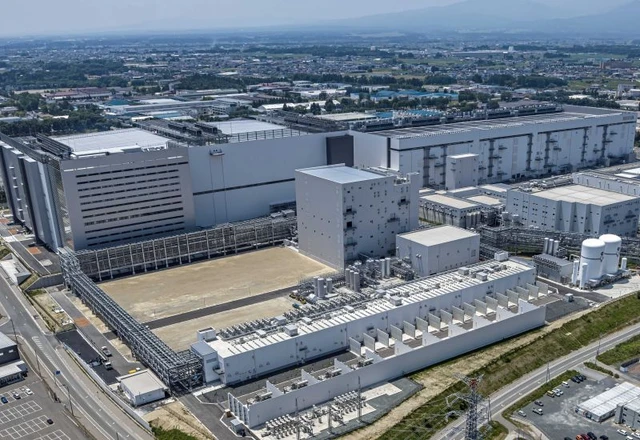
The production cycle for these cutting-edge chips will be centered at the new facility in Iwate Prefecture, which launched last September. Scaling capacity in this region underscores Kioxia's drive toward full technological autonomy and its ability to adapt rapidly to market fluctuations. The reaction from the Tokyo stock market—marked by a nearly nine percent surge in the company's shares—signals strong investor confidence in this strategic direction.
Kioxia’s strategic positioning on the global stage differs fundamentally from its primary rivals, Samsung and SK hynix. While the South Korean giants maintain diversified portfolios including DRAM and high-bandwidth memory (HBM), Kioxia remains a specialized player focused exclusively on NAND. While this specialization carries inherent risks, it simultaneously compels the company to be more aggressive in its pursuit of innovation.
Currently, Kioxia holds approximately 10% of the server NAND segment, while Samsung and SK hynix control 40% and 30% of the market, respectively. However, the advantages in data transfer speeds and storage density provided by the new 332-layer chips could serve as the catalyst Kioxia needs to close this gap. In an industry where technological leadership is measured in nanometers and layers, the ability to offer a faster, more energy-efficient solution can redistribute market shares in remarkably short order.
 The Price of Acceleration: CXMT’s Rapid Push into Memory