The vision of widespread supersonic travel has long been held hostage by the dual burdens of noise pollution and economic inefficiency. Today, the aviation industry is undergoing a renaissance, pivoting toward the concept of "quiet" supersonic flight—technology designed to breach the sound barrier without the accompanying destructive roar of a sonic boom. China's TMS-10 project represents a pivotal milestone in this global technological race, introducing innovative methodologies for shock-wave management. Such an initiative has the potential to fundamentally reshape the logistics of corporate travel, condensing grueling multi-hour journeys into swift, seamless transits.
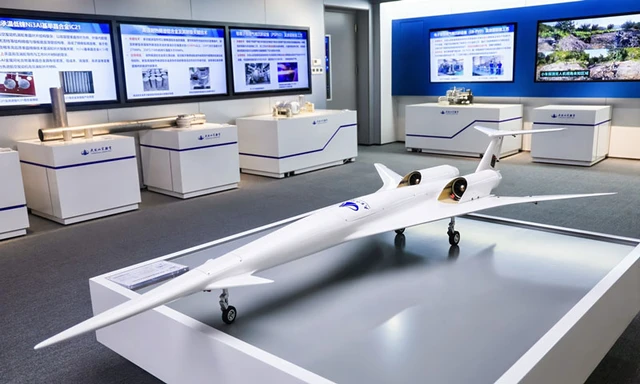
The era of civil supersonic aviation effectively came to a standstill with the retirement of the Concorde, primarily due to stringent environmental regulations and prohibitions on overland flights caused by the disruptive nature of the sonic boom. The current stage of aerospace engineering demands a fundamentally different philosophy: the creation of an aircraft that is not only fast but acoustically stealthy. This is the core objective of the TMS-10 project, which is currently in the final assembly stage of its demonstration model.
The primary challenge lies in the physics of sound propagation. When an aircraft breaks the sound barrier, it creates an abrupt pressure jump that is perceived on the ground as a powerful explosion. To mitigate this effect, the TMS-10 engineers have redesigned the geometry of the fuselage and wings. The goal is to transform a sharp, concentrated shockwave into a series of attenuated, time-extended acoustic oscillations.
On a global scale, this approach mirrors the American NASA X-59 project, though the latter focuses primarily on reflecting the shockwave upward toward the stratosphere. The Chinese concept, by contrast, relies on the synergy of three aerodynamic surfaces: the main wing and a specialized T-tail. This configuration allows for the controlled dampening and dissipation of shockwave energy, minimizing its impact on ground infrastructure.
The first practical steps toward realizing this vision have already been taken. In late June 2025, a scale prototype conducted its maiden flight at the Dingzhou airfield in Hebei Province. The aircraft—measuring 3 meters in length, weighing 12.5 kg, with a wingspan of 1.5 meters—reached a speed of 0.2 Mach (approximately 166 km/h). Despite operating in a subsonic regime, the tests confirmed the overall viability of the design and the aircraft's controllability, paving the way for full-scale supersonic testing scheduled before the end of the year.
The ultimate goal of the program is the development of a full-scale business jet designed for 10–15 passengers. In cruise mode, such an aircraft is intended to reach speeds of Mach 2 while maintaining efficiency at subsonic speeds (up to 0.9 Mach). The practical impact of implementing these technologies would be profound: for instance, a flight between Beijing and Shanghai could be reduced from the usual two hours to just thirty minutes.
However, engineering a "quiet" supersonic liner is not merely a matter of aerodynamics. Transitioning to a new generation of civil aviation requires a holistic solution to several concurrent challenges. Foremost among these are fuel efficiency and the development of propulsion systems capable of supersonic cruise without generating excessive noise during takeoff and landing. Furthermore, airport ground infrastructure will need to be adapted to meet the new maintenance and safety requirements of high-speed aircraft.
The TMS-10 exemplifies a broader global trend: aviation is moving away from a raw race for speed toward the intelligent orchestration of physical processes, where comfort and environmental compatibility become as critical as travel time.
 First Direct Radio Contact with an Exoplanet