The search for distant worlds is evolving, moving beyond the limitations of optical observation and into the domain of radio astronomy. In a landmark achievement, scientists have isolated a radio signal originating directly from an exoplanet, distinguishing it from the emissions of its host star. This breakthrough provides a new lens through which to study the invisible forces shaping remote planetary systems. The detection of radiation from Beta Pictoris b offers critical data on the pivotal role magnetospheres play in the evolution and long-term viability of planets.
For years, astronomers have detected radio emissions emanating from exoplanetary systems, yet these signals were almost invariably dismissed as "noise" from the host stars. This paradigm shifted with the detection of a signal from Beta Pictoris b—a massive gas giant situated 63.4 light-years from Earth. For the first time in observational history, radio emissions have been unequivocally attributed to the planet itself, transforming the object from a passive data point on a graph into an active radio source.
The technical realization of this breakthrough was made possible by the MeerKAT radio interferometer in South Africa. During a series of observation sessions between 2025 and 2026, researchers recorded two distinct types of emissions within the 0.85 to 3.5 GHz range: a stable background signal and a sequence of short, repeating bursts characterized by a high degree of circular polarization.
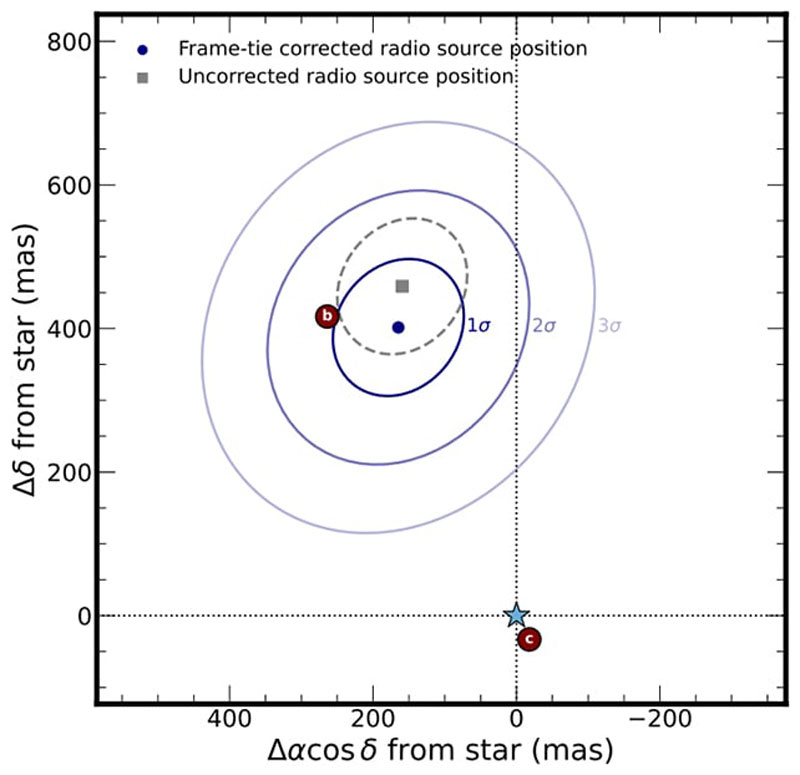
This physical profile points to a powerful natural mechanism driven by the planet's magnetosphere. The interaction of charged particles with the magnetic field accelerates them, generating electromagnetic radiation and triggering auroras. Such processes are well-documented within our own solar system, where Jupiter stands as the most luminous and potent natural radio transmitter among our celestial neighbors.
The key to identifying the source lay in MeerKAT’s high spatial resolution combined with the characteristic rhythm of the bursts. Data analysis suggests that the magnetic field of Beta Pictoris b may be thousands of times stronger than Earth's. This colossal magnitude is likely driven by the planet's rapid axial rotation—completing a full revolution in just 8 to 9 hours—which creates a powerful "dynamo effect" that generates the magnetic field.
The significance of this discovery extends far beyond the study of a single object. Radio astronomy has gained a fundamentally new instrument for analyzing exoplanetary magnetic fields. This is critical in the search for habitable worlds, as a robust magnetosphere serves as the primary shield protecting the atmospheres of rocky planets from the destructive impact of stellar winds. Without such a screen, even a planet with an ideal temperature would rapidly lose its water and gases, devolving into a lifeless wasteland.
Despite the sensational nature of the event, scientists are quick to clarify: Beta Pictoris b, with a mass ten times that of Jupiter, is not a candidate for hosting life. Consequently, the detected signals are the result of fundamental physical processes rather than an attempt at communication from an extraterrestrial civilization. Nevertheless, the confirmation of theoretical models regarding exoplanetary radio emissions moves theoretical astrophysics firmly into the realm of empirical evidence.

 The Hidden Hydrological History of Early Mars