The age of generative AI has ignited an insatiable demand for data storage. Cloud hyperscalers have pivoted from transactional procurement to strategic capacity reservations, securing production pipelines years in advance. Seagate’s latest roadmap, headlined by 50-terabyte drives, serves as a clear barometer for the sheer scale of the impending infrastructure expansion. At the core of this transformation lies a fundamental shift toward entirely new data recording methodologies.
The data storage landscape is undergoing a tectonic shift. Driven by the explosive growth of AI infrastructure and cloud computing, demand has reached such a scale that leading hardware providers are operating under conditions of severe scarcity. Seagate’s current situation is telling: a significant portion of the company's projected output through 2028 is already effectively pre-sold. Furthermore, strategic partners are now seeking to lock in supply volumes for 2029 and beyond, signaling deep market confidence in the long-term growth of exabyte-scale storage requirements.
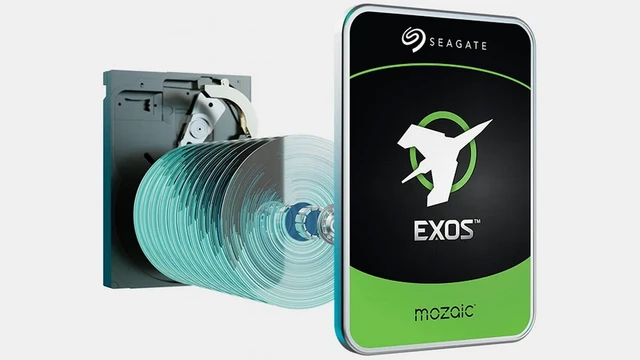
The primary engine of this growth is the Mozaic 5 platform. This third generation of commercial drives is based on Heat-Assisted Magnetic Recording (HAMR) technology. HAMR allows engineers to bypass the physical areal density limits of traditional recording methods by using a laser to momentarily heat the platter surface, making it more receptive to data writes. Under the Mozaic 5 architecture, Seagate aims to produce platters with capacities exceeding 5 TB; combined across ten platters, this enables total drive capacities surpassing 50 TB.
To accommodate diverse deployment scenarios, two implementation options are offered: Conventional Magnetic Recording (CMR) for those prioritizing performance and versatility, and Shingled Magnetic Recording (SMR), designed for maximum storage density.
The journey from development to real-world deployment for such devices is extensive. Certification testing for the 50 TB models is slated for late 2027. This phase involves rigorous internal validation focusing on magnetic head longevity, shock resistance, and vibration tolerance. Once internal approval is granted, the external cycle begins: server hardware manufacturers typically spend two to six months on certification, while hyperscalers—the world's largest cloud providers—conduct their own proprietary testing for six months to a year. Consequently, the mass integration of 50 TB drives into data centers is expected by 2028.
Seagate’s current market strategy relies heavily on Long-Term Agreements (LTAs), which lock in not only volumes and product configurations but also pricing. While this provides stability, the company employs a "value-based pricing" strategy for products not covered by these contracts. In an environment of surging demand, this creates opportunities to increase drive premiums, mirroring trends previously seen in the 3D NAND and SSD markets.
The transition to HAMR is accelerating. While such devices accounted for approximately 40% of the future shipment portfolio in mid-2024, that figure is projected to rise to 70% by July 2027. The Mozaic 4 platform serves as the interim bridge; its 40 TB drives are expected to constitute half of the company's total HAMR solutions by the end of 2026.
Financial metrics validate the efficacy of this trajectory. In the most recent reporting period, Seagate’s revenue showed substantial growth, reaching $3.629 billion per quarter compared to $2.444 billion a year earlier. Gross margin climbed from 37.4% to 52.3%, and annual net income more than doubled to $3.184 billion. These figures reflect more than just commercial success; they represent a fundamental industry mandate for new scales of information storage in the era of Big Data.
 The Era of Layoffs in the Global Tech Industry