For decades, free-space optical communication has been plagued by the persistent challenge of atmospheric turbulence. Random fluctuations in air density distort the light beam, degrading a pristine signal into chaotic noise. Conventional mitigation strategies rely on sophisticated adaptive optics systems designed to "correct" the light in real-time. However, an emerging approach rooted in electromagnetic field topology offers a radical alternative: rendering the information itself immune to the physical deformations of the beam.
The fundamental challenge of free-space optical (FSO) communication is rooted in the inherent volatility of the atmosphere. Air is non-homogeneous: thermal currents, pressure differentials, and stochastic fluctuations in the refractive index create a "shimmering" effect that effectively smears the laser beam. To combat this, conventional systems rely on adaptive optics—a complex array of deformable mirrors and ultra-high-speed sensors that attempt to compensate for distortions by restoring the beam to its original profile. This approach is costly, technically cumbersome, and introduces significant latency.
Researchers from the University of the Witwatersrand and the University of Bordeaux have proposed a paradigm shift. Rather than fighting atmospheric distortion, they have chosen to leverage properties that are fundamentally immune to it: the topology of light.
At the heart of this method is the use of light structures known as skyrmions. In physics, a skyrmion is a vortex-like field configuration characterized by a specific topological charge. By encoding information not as a pulse shape or wave amplitude, but as a topological state, the data becomes incredibly resilient. From a topological perspective, a circle and an ellipse are identical, as one can be continuously deformed into the other without breaking the line. The same principle applies to a laser beam: while atmospheric turbulence may stretch, compress, or warp the light spot, the underlying topological structure—where the data is encoded—remains invariant.
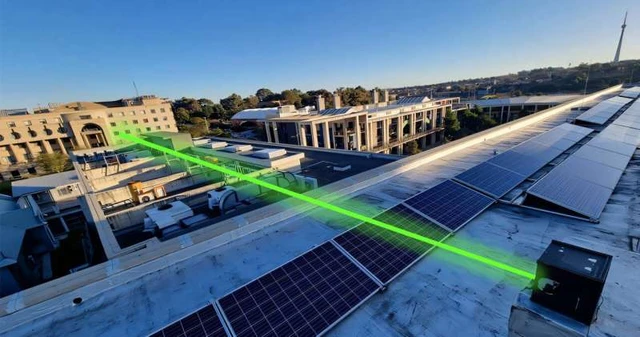
This hypothesis was put to the test in Johannesburg, where laser beams were transmitted between buildings on the University of the Witwatersrand campus over distances of several hundred meters. The experiment took place in a real-world urban environment, subject to natural turbulence caused by surface heating and air currents. The results were striking: although the light spot at the receiving end was visibly distorted compared to the source, the encoded topological information was retrieved without error.
This suggests that data transmission is possible without the need for preliminary distortion correction. We are moving from a paradigm of "signal correction" to one of "signal invariance."
Such a breakthrough opens vast horizons for the evolution of global communication networks. The most critical applications will be ground-to-air and ground-to-space links, where atmospheric interference is most acute. Utilizing the topological properties of light could provide the foundation for ultra-reliable communication links between ground stations, drones, and satellites.
This is particularly relevant for quantum communications, where any external perturbation can lead to a loss of coherence and the subsequent destruction of data. By embedding information within topological characteristics, the system is protected not merely from noise, but from the very possibility of losing the beam's fundamental structure—an outcome that is virtually impossible in open-space conditions.
 The Endurance Potential of the Vivo V80 Lite 5G