Global industry stands on the precipice of a fundamental paradigm shift in the conceptualization of labor. The transition from single-purpose machinery to general-purpose humanoid robots is evolving from the realm of science fiction into a tangible operational reality. Figure AI has become the first company in history to reach a symbolic milestone: a workforce where machines now outnumber humans. This precedent heralds the dawn of an era in which business scalability is no longer tethered to the constraints of human recruitment.
An event that until recently felt like a plot point from a cyberpunk novel has unfolded within the walls of Figure AI. The company has officially reached a tipping point: the population of its humanoid robots now surpasses its human headcount. This milestone, confirmed by internal statistics, reveals a stark divergence in the growth trajectories of human and machine capital.
The company's development dynamics from 2022 to 2026 vividly illustrate a transition from the R&D phase to full-scale industrial production. While the robot fleet was virtually non-existent prior to the first quarter of 2025, the subsequent quarters saw an exponential surge. By the end of 2025, the number of units climbed past one hundred, and by mid-2026, that figure hit 740 devices.
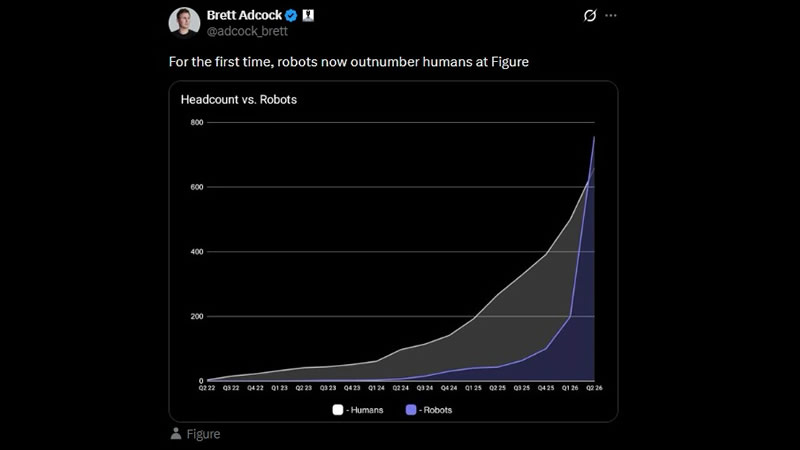
Against this backdrop, the growth of the human workforce appears modest and linear. By the end of 2025, the team had expanded to 400 specialists, reaching approximately 660 by 2026. This pronounced disparity in trajectories indicates that the integration of autonomous systems into workflows is occurring far more rapidly than the recruitment and onboarding of new engineers and developers. In essence, the company has pioneered a self-scaling enterprise model, where each additional robot increases the system's overall capacity without requiring a proportional increase in administrative or technical overhead.
The symbol of this new reality is the sight of dozens of humanoid machines in packaging crates bearing the concise label: Power On. This is more than a mere logistical operation; it is a demonstration of the technology's readiness for mass deployment across the real-world economy.
The path to this dominance has not been without its hurdles. The company previously conducted a high-profile experiment in which the Figure 03 model was pitted against an intern in a parcel-sorting competition over a full eight-hour shift. In that encounter, the human emerged victorious. However, leadership viewed this result not as a defeat, but as a benchmark. The assertion that this was the "last human victory" over a machine in such tasks underscores the blistering pace of iteration in the neural networks governing robotic kinematics.
The Figure AI case aligns with a global trend toward pervasive automation. We are currently witnessing tech giants like Amazon and Meta optimizing their structures by cutting thousands of jobs in favor of AI algorithms. In the race to create the ideal general-purpose assistant, Figure AI now competes with industry titans such as Tesla and its Optimus project, as well as ambitious Chinese developers like Unitree and Agibot.
Ultimately, the situation at Figure AI is not merely a corporate anomaly; it is a harbinger of a new economic paradigm—one in which human labor ceases to be the primary bottleneck for production growth.
 The Economic Paradox of the GeForce RTX 5090