The global AI boom has catalyzed an unprecedented surge in demand for computational power, transforming system memory into one of the most contested resources of the modern age. With inventories plummeting to critical lows, DRAM manufacturers are confronting a landscape where market requirements far outstrip production capabilities. This imbalance has sparked a sharp escalation in contract pricing and driven explosive growth in financial performance. The industry is now navigating a profound structural shift, with strategic priorities pivoting toward specialized, high-speed memory architectures designed specifically for server-scale systems.
The semiconductor memory market is currently navigating a period of turbulent growth. According to data from analytical agency TrendForce, total DRAM industry revenue in the second quarter of this year surged by nearly 60%, reaching $154.73 billion. This rapid financial ascent was driven by a sharp increase in contract pricing for memory modules, allowing vendors to significantly boost revenues even amidst moderate growth in physical shipment volumes.
The primary catalyst for this momentum has been the aggressive expansion of artificial intelligence infrastructure. The training and deployment of Large Language Models (LLMs) demand massive memory bandwidth, fueling demand for specialized solutions: high-speed HBM3E memory, energy-efficient LPDDR5X modules, and server-grade RDIMMs of varying capacities. Faced with historic inventory lows, manufacturers have been compelled to pivot their primary production streams toward the server segment, effectively sidelining the consumer market.
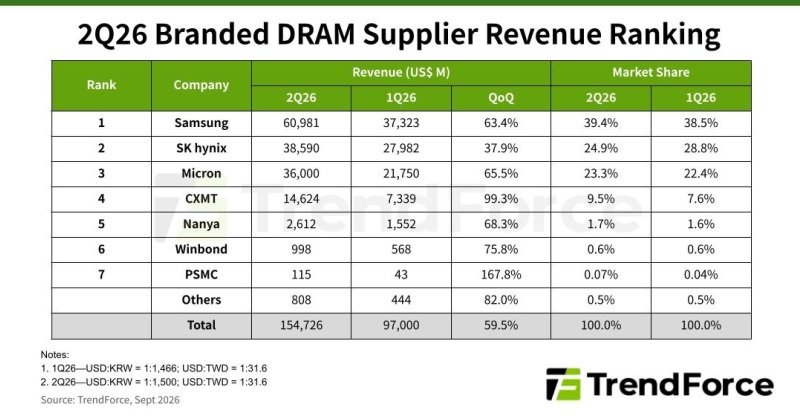
Samsung continues to hold the lead in this race for technological dominance. The company demonstrated the most impressive growth in bit-shipments, facilitated by the early launch of mass production for next-generation HBM4 memory. The combination of a technological head start and rising average selling prices (ASP) allowed Samsung to push its quarterly revenue to $60.98 billion—a 63.4% increase over the previous period. Consequently, the company's global market share has solidified at 39.4%.
SK hynix, occupying the second position, has bet heavily on maximizing the concentration of HBM within its portfolio. While the company maintained the highest proportion of HBM shipments among the top three leaders, its ASP growth remained more tempered. Nevertheless, SK hynix saw its revenue climb 37.9% to $38.59 billion, with its market share adjusting to 24.9%.
Micron remains the third major player, employing a strategy of strict prioritization. Faced with limited production capacity, the company focused on the highest-margin server DRAM. This pragmatic approach yielded a 65.5% quarterly revenue increase, bringing the total to $36 billion and expanding its market share to 23.3%.
Parallel to the dominance of these giants, an interesting phenomenon is emerging among secondary players. Companies such as Nanya, Winbond, and PSMC have focused on production using mature process nodes. As market leaders migrate to advanced nodes—creating a deficit of baseline solutions—smaller vendors are successfully capturing these gaps. A sharp price spike for legacy DDR3 and DDR4 standards has triggered phenomenal revenue growth: Nanya increased its figures by 68.3% (to $2.612 billion), Winbond grew by 75.8% (to $998 million), and PSMC recorded a revenue jump of 167.8%, reaching $115 million.
In the medium term, looking toward 2026–2027, the top three leaders are expected to continue scaling shipment volumes through aggressive process node migration. However, price growth is likely to decelerate to a quarterly rate of 13–18%. This shift will be driven by a gradual migration in demand from ultra-high-capacity RDIMMs toward lower-capacity products, as well as the price ceilings encountered in the PC and smartphone segments. Nevertheless, the deficit in the consumer segment may trigger localized price spikes, as manufacturers intentionally restrict supply to this sector.
 The Triumph of 3nm Chip Manufacturing