The universe veils its most profound mechanisms behind dense shrouds of cosmic dust. For decades, astronomers have struggled to peer through these opaque barriers to decode the mechanics driving the evolution of stellar systems. The deployment of the James Webb Space Telescope has fundamentally shifted the paradigm, granting humanity unprecedented resolution across the infrared spectrum. Now, the latest imagery of the Centaurus A galaxy is proving pivotal, offering a window into the intricate symbiosis between supermassive black holes and their host galaxies.
Centaurus A, located 11 million light-years from Earth, has long captivated astronomers with its anomalous activity and eccentric morphology. Unlike many of its neighbors, it serves as a veritable cosmic laboratory where some of the most dramatic scenarios of matter evolution unfold. At the heart of this structure lies a supermassive black hole that, by consuming surrounding matter, generates colossal energy fluxes, transforming the galaxy into an Active Galactic Nucleus (AGN).
The distinctive appearance of Centaurus A is the legacy of a catastrophic event that occurred approximately two billion years ago. A collision with another galaxy left an indelible mark in the form of a chaotic structure and massive dust lanes that effectively bisect the system's disk. This unique characteristic makes the object an ideal candidate for studying the co-evolution of black holes and their surrounding stellar environments.
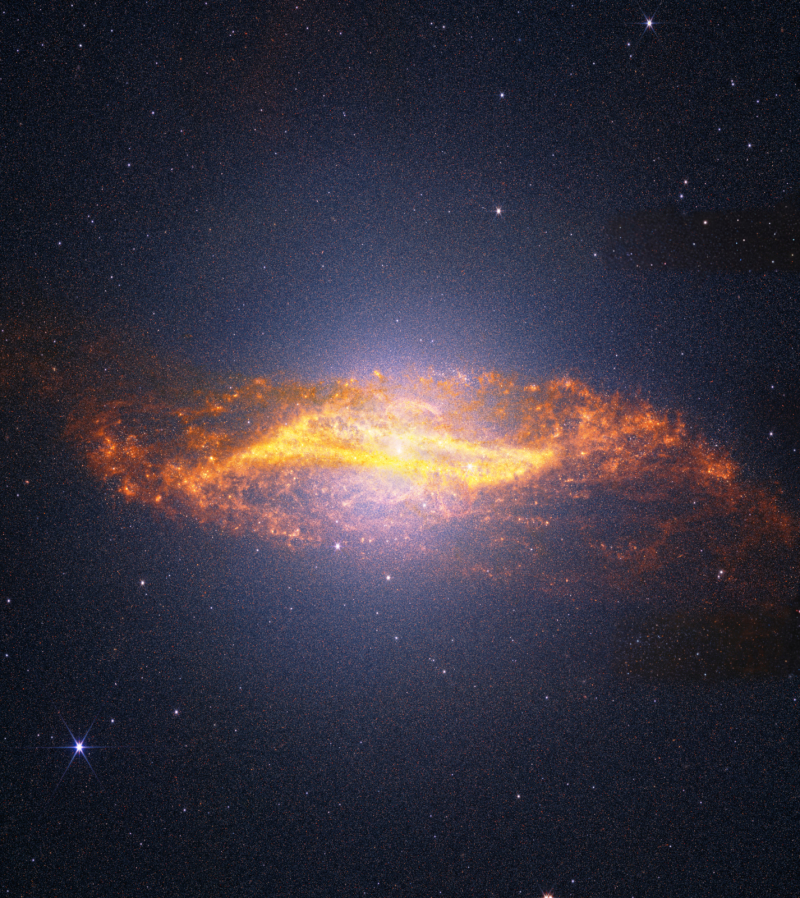
The path toward a detailed understanding of Centaurus A has been fraught with challenges due to the physical limitations of observational instrumentation. The renowned Hubble Space Telescope, operating primarily in the visible spectrum, was stymied by dense dust clouds that blocked light, rendering the galaxy's core an opaque barrier. Later, the Spitzer Space Telescope managed to capture the system's general outlines via infrared radiation; however, its resolution was insufficient to isolate individual stars, leaving scientists with a blurred impression of the overall structures.
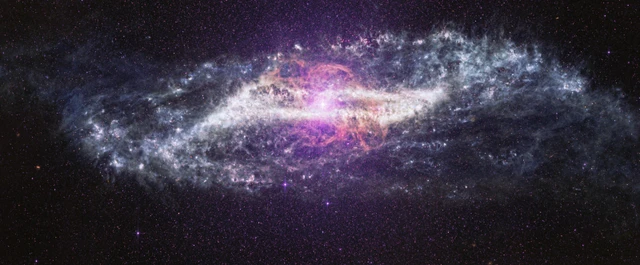
The breakthrough arrived with the deployment of the Mid-Infrared Instrument (MIRI) aboard the James Webb Space Telescope. Operating in the mid-infrared range, MIRI effectively pierced the dust veils, exposing intricate details that had previously remained invisible. The resulting imagery revealed glowing reddish-purple points—zones of intense star formation known as "stellar nurseries"—as well as aging stars shedding their outer envelopes of matter.
To achieve a comprehensive perspective, MIRI's data were integrated with results from NIRCam, which operates in the near-infrared spectrum. This synergistic approach allowed astronomers to transition from a broad overview to a granular analysis of individual stars.
Now, with the ability to essentially catalog the stars within this complex system, scientists are beginning to reconstruct the evolutionary timeline of Centaurus A. This effort will not only recover the history of a single collision but also help establish a general model of how such cosmic catastrophes shape the architecture of the modern universe.
 Next-Generation Ultra-Lightweight Lens Technology