The fundamental tenets of chemical bonding, staples of university curricula for decades, have proven accurate only for light elements. As we descend toward the bottom of the periodic table, physical laws typically reserved for the vastness of deep space and the crushing gravity of black holes begin to take hold. Einstein’s theory of relativity exerts a direct influence on how atoms interact at the quantum level; new research demonstrates that in heavy elements, traditional distinctions between types of chemical bonds dissolve, giving rise to a fundamentally different architecture of matter.
The fundamental architecture of chemistry is built upon the mechanism of electron exchange. When two atoms seek to bond, they form shared electron pairs that attract positively charged nuclei, binding them together. Depending on the number of these pairs, single, double, or triple bonds are formed. According to the classical model, a triple bond is a strictly structured ensemble: one robust "head-on" sigma bond aligned along the axis between the nuclei, and two weaker "lateral" pi bonds that envelop the central axis.
While this paradigm holds true for lighter elements, its relevance diminishes as we descend the periodic table. When an atomic nucleus becomes sufficiently massive, electrons in the inner orbitals begin to move at colossal velocities, reaching a significant fraction of the speed of light. At this threshold, relativistic effects emerge, fundamentally altering particle behavior.
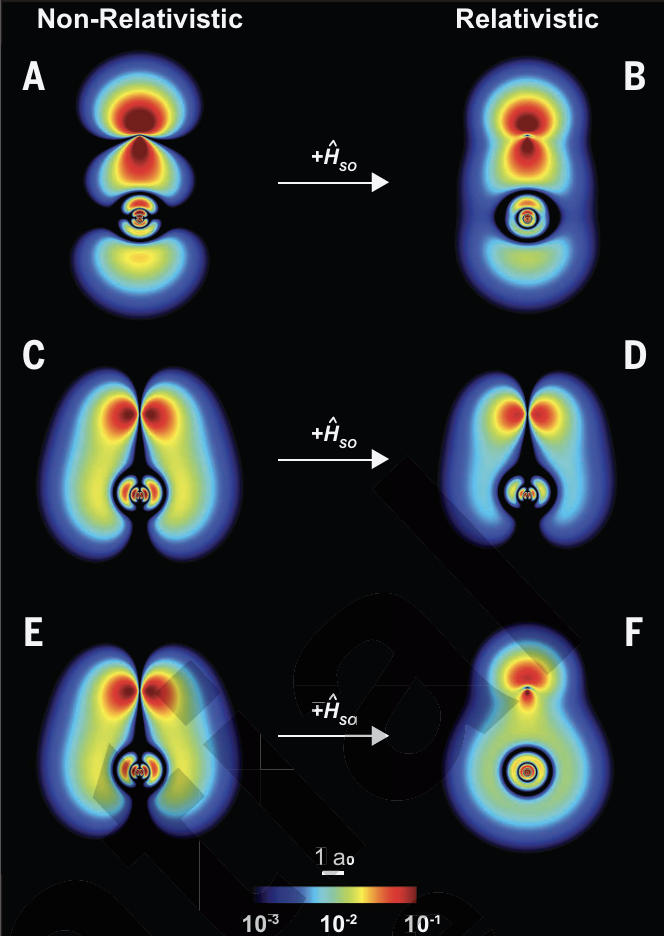
The pivotal driver here is spin-orbit coupling. Under normal conditions, an electron's spin (its intrinsic magnetic moment) and its orbital motion operate independently. However, in a relativistic regime, this independence vanishes: spin and orbit merge into a single system. Consequently, the rigid distinction between sigma and pi bonds begins to blur. In heavy elements, there is no longer a clear boundary between "head-on" and "lateral" interactions; instead, a hybridized state emerges—one that cannot be described using the terminology of classical textbooks.
To empirically validate this hypothesis, researchers synthesized a molecule composed of carbon and bismuth. Positioned adjacent to lead in the periodic table, bismuth possesses an immense atomic mass, making it an ideal subject for studying relativistic effects. To eliminate thermal noise and achieve maximum precision, the molecules were cooled to temperatures approaching absolute zero.
The analysis was conducted using photoelectron spectroscopy. The essence of this method involves striking the molecule with a laser pulse, which effectively ejects individual electrons from their positions. By measuring the kinetic energy of these emitted particles, researchers can determine the strength of the bond that held the electron with high precision.
The spectroscopic results were definitive: carbon-bismuth bonds do not adhere to the traditional "one sigma and two pi" blueprint. Instead, the structure consists of one full pi bond and two hybrid sigma-pi bonds. This discovery does more than simply refine chemical nomenclature; it demonstrates that high-speed physics dictates the very nature of matter across the heavier end of the chemical spectrum.

 Optical Technologies for Combating Counterfeiting