The global energy transition is confronting a systemic hurdle: the inherent intermittency of renewables and their dependence on diurnal cycles. The solution lies in the strategic synergy of diverse solar harvesting technologies, enabling energy accumulation without relying on cost-prohibitive chemical storage. A landmark project recently launched in Xinjiang is redefining the paradigm of utility-scale power generation; the facility serves as a proof-of-concept for how the hybridization of photovoltaics (PV) and Concentrated Solar Power (CSP) can maintain grid stability long after the sun has set.
The challenge of solar intermittency has long been the primary bottleneck preventing a total transition away from fossil fuels. While traditional photovoltaic (PV) panels are efficient, they are powerless after dark, and megawatt-scale lithium-ion storage systems remain prohibitively expensive and ecologically taxing. The solution to this dilemma has emerged from the Gobi Desert, where the Three Gorges Corporation has deployed a 1 GW hybrid plant that integrates two fundamentally different methods of harnessing solar radiation.
The system is bifurcated into two functional zones: a 900 MW photovoltaic array and a 100 MW Concentrated Solar Power (CSP) block. While the PV panels provide instantaneous conversion of light into electricity for immediate grid consumption, the CSP section operates as a massive thermal battery.
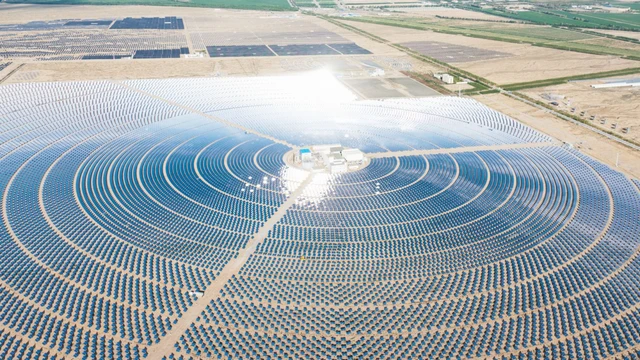
At the technological core of the plant lies an array of 260,000 high-precision tracking mirrors that focus sunlight onto a central receiver. This process heats molten salt to 550°C. Due to its immense heat capacity, this medium stores energy that can later be used to generate steam, driving turbines long after the sun has dipped below the horizon. Consequently, the plant can maintain full-scale generation for an additional eight hours post-sunset, effectively covering evening peak demand.
The project's engineering is based on a linear Fresnel reflector design, which in this specific modification demonstrates a 10% increase in thermal conversion efficiency compared to standard industry solutions. Particular emphasis has been placed on fault tolerance: a configuration of 46 independent loops allows for the maintenance of individual units without requiring a full system shutdown. The entire operation is managed by a centralized digital controller that ensures precision grid frequency regulation within 0.02 Hz and a response time of less than one second—capabilities critical for preventing cascading failures in the regional power grid.
The scale of the facility is staggering: nearly 1,817 hectares at the foot of the Tian Shan mountains have been transformed into a high-tech energy hub. With an implementation cost of approximately $480 million, the project appears to be a justified long-term investment given its current efficiency metrics.
The economic and environmental impact of the plant extends beyond simple kilowatt-hour production. A projected annual yield of 2.07 TWh is capable of powering roughly 830,000 households. From an ecological standpoint, the project reduces carbon dioxide emissions by 1.63 million metric tons annually, significantly accelerating the Xinjiang region's progress toward its goal of achieving over 95% renewable energy penetration.
The launch of this complex not only solidifies China's technological leadership in green energy but also shifts the global balance of power. By surpassing the capacity of Dubai's Noor Energy 1, the Hami project becomes a new global benchmark for hybrid systems. It proves that the future of solar energy lies not merely in increasing the number of panels, but in creating sophisticated, multi-component systems capable of mimicking the stability of traditional baseload power plants.
 Optical Technologies for Combating Counterfeiting