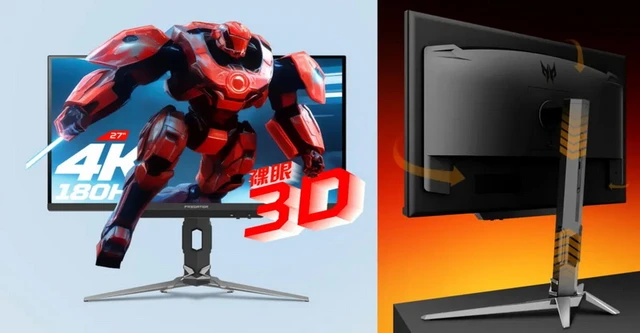
The quest for total immersion in digital content has long been hampered by cumbersome VR headsets and awkward stereoscopic eyewear. Current industry trends are pivoting toward autostereoscopic displays—technology capable of generating a native sense of depth without the need for external aids. The debut of the Predator XB273K 3D represents a strategic effort to fuse uncompromising gaming performance with the principles of spatial computing, aiming to dissolve the boundary between the traditional flat screen and a tangible, three-dimensional presence.
The technological leap behind the Predator XB273K 3D is driven by the SpatialLabs ecosystem, which enables a glasses-free volumetric viewing experience. This process relies on a sophisticated synergy of hardware and software: an integrated high-resolution camera continuously tracks the user's eye position and movement, instantaneously adjusting the perspective of the stereoscopic image. The result is a "window into another world" effect, where the depth of the scene shifts dynamically in sync with the user's head movements.
To achieve this, the system leverages not only the raw power of the connected PC's GPU but also on-device AI models. The SpatialLabs 3D Hub software handles the heavy lifting—converting standard 2D content into a 3D format in real time. This expands volumetric viewing beyond purpose-built 3D files and compatible games to include ordinary video content, effectively transforming static media into an immersive spatial environment.
From a technical standpoint, the device is a high-performance powerhouse designed for both gaming and professional creative workflows. It features a 27-inch IPS panel with 4K resolution (3840 × 2160 pixels), ensuring exceptional pixel density and razor-sharp detail. A 180Hz refresh rate, paired with a minimal 0.5ms (GtG) response time, ensures the monitor remains a formidable contender even in the most demanding esports disciplines.
Color fidelity is meticulously calibrated: 95% DCI-P3 coverage makes it indispensable for modern digital cinematography and high-end rendering. A peak brightness of 400 nits guarantees image clarity even under intense ambient lighting, while support for AMD FreeSync Premium and Nvidia G-Sync eliminates screen tearing and ensures seamless motion fluidity.
The connectivity suite is engineered to meet the demands of contemporary hardware. HDMI 2.1 ports allow for lossless transmission of high-resolution signals at high refresh rates, while DisplayPort 1.4 ensures stability in professional scenarios. Additional USB 3.2 ports and an integrated 10W audio system transform the device into a comprehensive hub for a streamlined workstation. Ergonomics are equally refined: the stand offers full adjustability for height, tilt, and swivel, including a native portrait mode.
The go-to-market strategy involves a phased rollout. The technology first debuted in China, where it was priced at approximately $1,100. Future expansion into North American and European markets is planned, with pricing adjusted for regional taxes and logistics, expected to reach the $1,300 and $1,500 marks, respectively.
 The Strategic Alliance of Nvidia and MediaTek