The contemporary electric vehicle market has evolved into a theater of high-tech marketing, where the promise of "revolutionary" battery breakthroughs has become the primary lever for consumer acquisition. Yet, a profound chasm persists between laboratory milestones and large-scale industrial deployment. Tech titan CATL is now urging the industry toward a more pragmatic approach, outlining realistic timelines for the integration of next-generation solutions. The transition to sodium-ion and solid-state systems will demand more than just time; it will require overcoming fundamental engineering hurdles.
In the race for dominance within the Chinese electric vehicle (EV) market, manufacturers are increasingly leveraging promises of next-generation traction batteries as a strategic marketing tool. However, the reality of industrial-scale manufacturing remains far removed from these promotional slogans. According to leadership at CATL, the mass adoption of sodium-ion or solid-state batteries is unlikely to occur for another three to five years.
Particular attention is focused on solid-state batteries, widely regarded as the industry's "Holy Grail" due to their superior energy density and enhanced safety profiles. Nevertheless, the journey from lab prototype to the assembly line is a complex, multi-stage process. CATL has identified nine critical milestones for mass production readiness; currently, the company has cleared only four. Even when samples demonstrate flawless stability in controlled laboratory settings, scaling the technology inevitably triggers significant challenges—ranging from ensuring material homogeneity to optimizing production cycles.
Parallel to these technical developments, a regulatory framework is emerging. To prevent consumer deception, Chinese regulators are implementing strict classification criteria. Under the new requirements, a battery can only be labeled "solid-state" if its liquid electrolyte content does not exceed 5%. If the liquid content falls between 5% and 20%, the battery is classified as a hybrid.
From a commercial standpoint, hybrid solutions are exceptionally attractive: producing them requires only a 10% modification of existing lithium-ion production lines. This explains why many ambitious claims from competitors—such as Dongfeng Motor’s promises of a 1,000 km range—likely refer to hybrid systems rather than true solid-state solutions.
CATL’s roadmap suggests that the certification of pilot batches for solid-state batteries will begin as early as next year. By 2027, the company aims to reach the seventh or eighth stage of preparation, bringing it to the threshold of a full-scale launch.
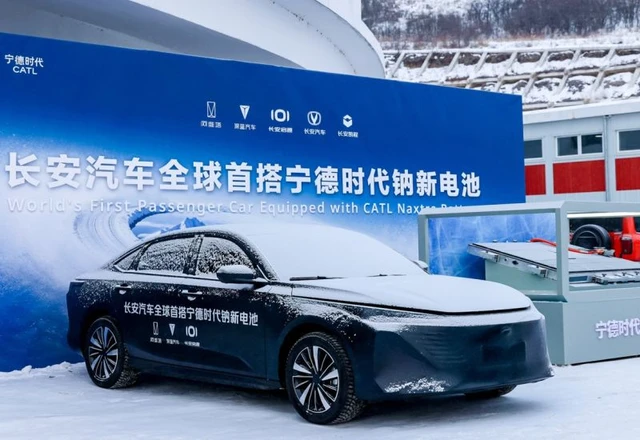
A separate development track has emerged in the form of sodium-ion batteries. Their primary advantage is exceptional efficiency in low-temperature environments, a critical factor for northern regions. However, the industry is currently grappling with the issue of operational longevity. While mobile devices and transport require high cyclic stability, current developments are struggling to meet the necessary durability benchmarks.
Consequently, a divergence in market application is becoming evident. For stationary energy storage systems (ESS), where requirements for mass and energy density are less stringent, sodium-ion batteries are an ideal solution. This is the direction pursued by Hithium Energy Storage, which is striving to achieve a lifespan of 20,000 charge-discharge cycles. General Motors has shown similar interest, exploring sodium-ion systems to power data centers.
Despite the caution expressed by some experts, CATL remains optimistic about the application of sodium-ion technology in transport. The company expects tens of thousands of EVs to be equipped with these batteries by the end of this year. Furthermore, sodium-ion systems are expected to reach price parity with lithium-ion alternatives in the near future, a shift that could radically transform the economics of the entry-level EV segment.
 The Evolution of Solid-State Batteries: From Smartphones to Electric Vehicles