The boundary between classical physics and the quantum realm is often blurred by the relentless pull of Earth's gravity. To transcend this barrier, NASA leverages the unique environment of the International Space Station, where the laws governing the motion of matter are fundamentally altered. The recent upgrade of the Cold Atom Lab marks a new era in the manipulation of matter at temperatures approaching absolute zero. This facility transforms the vacuum of space into a precision instrument for exploring the fifth state of matter and seeking answers to the most fundamental mysteries of the universe.
On Earth, studying quantum effects is akin to attempting to examine the intricacies of a complex mechanism through a distorted lens. Gravity forces particles to move and fall, severely limiting the window for observing their intrinsic nature. This is precisely why the Cold Atom Lab (CAL)—a one-of-a-kind orbital facility—was deployed aboard the ISS. In the environment of microgravity, the quantum properties of atoms persist significantly longer, granting scientists a glimpse into a realm that remains virtually inaccessible to such detailed analysis on the ground.
At the heart of the laboratory lies the creation of a Bose-Einstein Condensate (BEC). This exotic fifth state of matter emerges when atoms are cooled to temperatures approaching absolute zero (approximately -273°C). At this threshold, conventional notions of matter collapse: rather than behaving as a collection of discrete particles, a cloud of rubidium or potassium atoms merges into a single, giant quantum object. In this state, the wave-like properties of matter become dominant, allowing researchers to study quantum mechanics on a macroscopic scale.
The technical workflow required to achieve this state is a sophisticated, multi-stage operation. First, metallic strips of rubidium or potassium are heated to roughly 400°C, transforming them into an atomic gas within a vacuum chamber. Then, lasers tuned to precise frequencies take over, effectively "bombarding" the atoms to strip away their kinetic energy and decelerate their movement to a minimum. The final stage involves capturing the gas in a magnetic trap followed by a series of refinements that bring the cloud to a state of near-total stillness.
The primary advantage of orbital deployment is that, aboard the ISS, the atomic cloud does not "fall" under the influence of gravity. This significantly extends the condensate's lifetime and enables the manipulation of larger quantum waves—factors critical for ultra-precise measurements of time, gravity, and particle dynamics.
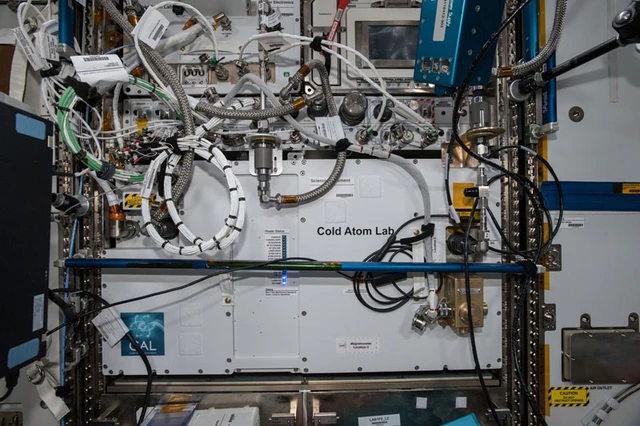
The latest upgrade—the fourth since CAL's launch in 2018—has substantially expanded the facility's functional capabilities. The compact module, roughly the size of a household mini-fridge, now features updated metallic atomic gas sources and, more crucially, a new magnetic trap. Scientists can now manipulate the shape of quantum gas clouds, allowing them to test various atomic system configurations and study their interactions within novel geometries.
However, NASA's objectives extend beyond mere academic curiosity. The Cold Atom Lab serves as a strategic stress test for the viability of quantum technologies in deep space. In the long term, these developments will provide the foundation for next-generation atom interferometers. Such instruments could deliver unprecedented navigational precision, perfect time synchronization, and detailed gravitational probing of not only Earth, but the Moon and other planets in the solar system, transforming quantum physics into a practical tool for space exploration.
 SpaceX’s Hundred-Billion Dollar Leap into Louisiana