For years, the advancement of quantum communications has been hampered by a reliance on costly, energy-intensive laser systems. The generation of entangled photon states was long believed to be contingent upon the strict coherence of the light source. However, a recent breakthrough by researchers from the University of Ottawa and the Max Planck Institute has upended this paradigm, demonstrating that ordinary solar radiation can be effectively utilized for this purpose. This milestone paves the way for a new generation of accessible, energy-efficient quantum technologies.
Modern quantum optics is anchored by the concept of entanglement—a state where two particles become so inextricably linked that a change in the state of one is instantaneously reflected in the other, regardless of the distance separating them. The gold standard for generating these pairs has long been Spontaneous Parametric Down-Conversion (SPDC). In this process, a high-energy "pump photon" traversing a nonlinear crystal splits into two lower-energy photons, forging a quantum bond between them.
Until recently, the field relied exclusively on coherent lasers. High spatial and temporal coherence was considered a prerequisite for the formation of entanglement. Sunlight, by contrast, is a chaotic flux of photons with varying directions and wavelengths—a reality that rendered the prospect of extracting quantum correlations from it nearly hopeless in the eyes of the academic establishment.
Researchers from the University of Ottawa and the Max Planck Institute challenged this orthodoxy, hypothesizing that even within the incoherent stream of sunlight, a common denominator exists: polarization. By preserving a specific order of electric field oscillations, they were able to cut through the noise of solar radiation and achieve a breakthrough.
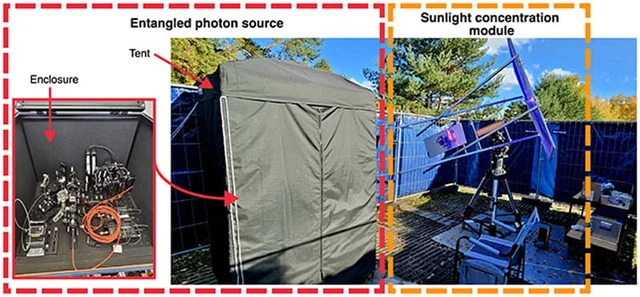
The technical execution demanded a precision-engineered light concentration system. To deliver sufficient energy to a microscopic nonlinear crystal, the team developed a conical glass concentrator. The system functioned like a funnel: a large Fresnel lens gathered light from an area of approximately 1.4 m², channeling it into an optical fiber no thicker than a human hair, which then focused the beam directly onto the crystal. To maintain a steady stream, an automated solar-tracking system was employed, allowing the experiment to be conducted effectively in field conditions.
The results were striking: the resulting photonic state exhibited a 94% fidelity to ideal quantum entanglement. Furthermore, the measured correlations violated Bell's inequalities—the fundamental mathematical benchmark proving that these phenomena cannot be explained by classical physics, confirming that we are indeed witnessing quantum effects.
The practical implications of this discovery are profound. In the realm of quantum communications—specifically the development of satellite-based Quantum Key Distribution (QKD) systems—leveraging natural sunlight could radically reduce the mass and power consumption of spacecraft by eliminating the need for heavy laser arrays and their associated power supplies.
Beyond its utility, the experiment carries a significant ideological weight. It demonstrates that quantum research can transcend the confines of sterile laboratories and multi-million dollar equipment. The history of IT reminds us that the first personal computers were born in garages; perhaps this democratization of tools will pave the way for the first home-based quantum systems.
 Next-Generation Ultra-Lightweight Lens Technology