The contemporary energy storage landscape has collided with a "graphite ceiling," a threshold beyond which the evolution of traditional lithium-ion batteries has reached a point of diminishing returns. The quest for alternatives has become imperative—not only for the automotive sector but for the burgeoning ambitions of electric aviation, where every single kilogram is a critical variable. Recent research from Chinese scientists advocates for a transition toward lithium-metal systems, promising a radical leap in energy density. Yet, these staggering performance gains come with a significant trade-off: a compromise in system stability and operational longevity.
The era of conventional lithium-ion batteries utilizing graphite anodes is steadily approaching its physical ceiling. The theoretical maximum specific energy for such systems hovers around 350 Wh/kg, and modern commercial cells have already neared this limit. For electric vehicles, this translates to a stagnation in range relative to battery weight; for aviation, it represents an insurmountable barrier that renders long-haul electric flight technically unattainable.
The way out of this impasse lies in lithium-metal batteries. The core innovation is the replacement of the traditional graphite anode with pure metallic lithium. This shift allows for a significant reduction in cell mass while simultaneously increasing energy storage capacity. However, the transition to metallic lithium introduces formidable engineering hurdles: the metal's high reactivity accelerates electrolyte decomposition and triggers the formation of dendrites. These microscopic, needle-like lithium growths can penetrate the separator, causing internal short circuits and, in the worst-case scenario, leading to thermal runaway and system combustion.
To mitigate these risks, researchers have implemented a strategy of creating artificial protective interfaces. Rather than relying on spontaneous natural processes, specific additives are introduced into the electrolyte to form thin-film coatings on the electrode surfaces during operation. A protective layer on the cathode prevents degradation under high-voltage conditions, while a modified layer on the lithium anode ensures uniform ion transport and suppresses the growth of dendrites.
Experimental results from 10 Ah pouch cells have proven highly promising. The use of high-nickel NMC (nickel-manganese-cobalt) cathodes enabled a specific energy of 550 Wh/kg. However, the true breakthrough occurred with the application of a high-manganese cathode, pushing the energy density to 603 Wh/kg. This is nearly 1.5 times the capacity of the best commercial samples currently available on the market.
Despite this triumph in energy density, the technology has revealed a critical vulnerability in its cycle life. The prototypes retained approximately 80% of their initial capacity after only 180 charge-discharge cycles. While this may suffice for consumer electronics or specialized aviation systems, it is unacceptable for the mass automotive market, where battery lifespans must be measured in thousands of cycles. This suggests that the journey from laboratory prototype to mass-market product will be protracted, requiring further breakthroughs in interface chemistry.
Simultaneously, the industry is looking even further ahead. Market leader CATL is exploring lithium-air systems, which could theoretically provide an energy density of up to 12,000 Wh/kg. Such figures are comparable to the energy density of liquid hydrocarbons, effectively signaling the possibility of a total departure from fossil fuels in aviation. Nevertheless, the current success with lithium-metal cells serves as a vital intermediate milestone, proving that the "graphite ceiling" can be shattered, albeit through a radical reimagining of electrochemical safety and stability.
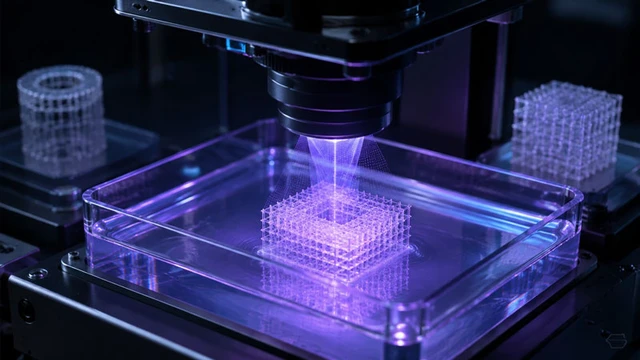 Light-Based Fabrication of Three-Dimensional Microstructures