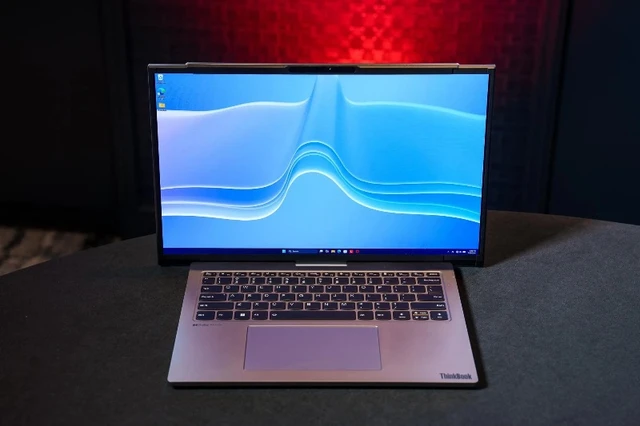
The tension between portability and productivity has long been an insurmountable trade-off for professionals. For years, users were forced into a binary choice: the agility of a 14-inch form factor or the uncompromising power of a cumbersome workstation. Lenovo seeks to dissolve this dichotomy, unveiling a concept that defies the physical constraints of contemporary hardware. Project Swan introduces a dynamic interface designed to adapt to user workflows in real time.
Unveiled at IFA 2026, the ThinkBook Project Swan concept marks a pivotal shift in the evolution of mobile productivity tools for the enterprise segment. At the heart of the device lies an ambitious vision of versatility: the laptop's OLED display is capable of expanding horizontally, transforming a standard 14-inch panel into a full-fledged 17-inch screen with a classic 16:9 aspect ratio.
Lenovo's foray into expandable displays is far from a random impulse. The company has already charted a course from bold prototypes to commercial releases, including the ThinkBook Plus Gen 6. However, while previous iterations often focused on vertical expansion—which felt more like a novelty than a utility—Project Swan bets on restraint and ergonomics. Unlike gaming concepts that showcased radical leaps from 16 to 24 inches, Swan is tailored for a pragmatic business use case, where the critical balance lies between portability and available workspace.
From a hardware perspective, the device shows immense promise. With a chassis thickness of 17.9 mm and a weight of 1.6 kg, the laptop only marginally trails modern ultrabooks, yet it offers the capabilities of a large-format screen. Visually, Project Swan does not feel like a rough prototype; rather, it appears as a product nearing production-ready maturity.
Yet, such technological leaps inevitably demand engineering compromises. The primary pain point is the top lid: it is significantly thicker than standard panels, which inevitably restricts the screen's opening angle. Furthermore, the shift in the center of gravity and the increased mass of the display module place substantial stress on the hinge mechanism. The reliability of this component will be the deciding factor in transitioning from a concept to a viable commercial product.
Under the hood, Project Swan is powered by the Intel Lunar Lake platform. The choice of this processor family is driven by a pursuit of maximum power efficiency and the integration of advanced Neural Processing Units (NPUs)—critical requirements for devices sporting power-hungry OLED panels. It is evident that by the time the device potentially hits the market, the internal hardware will be updated to more current chip generations.
The economic viability remains the most formidable challenge. Lenovo's previous attempts to commercialize similar solutions, such as the ThinkBook Plus Gen 6, resulted in steep price points (approximately $3,500), significantly narrowing their target audience. Amidst component market volatility and the inherent complexity of manufacturing flexible or expandable panels, finding the sweet spot between an innovative form factor, long-term durability, and a competitive market price remains the project's primary strategic objective.
 Nvidia N1X and the New Era of Arm PCs