The secondary market for high-performance hardware has long been a minefield for the uninitiated. Driven by the current frenzy surrounding AI and gaming, flagship solutions like the RTX 4090 have become prime targets for increasingly sophisticated scammers. Where the counterfeit industry once stopped at the simple relabeling of legacy chips, modern fraud has descended into the realm of the utterly absurd. A recent incident underscores a chilling trend: beneath the exterior of a purportedly powerful GPU may lie nothing more than a useless slab of plastic.
The story of a flagship graphics card purchased for a suspiciously low price—1,500 yuan (approximately $220)—serves as a stark reminder of a timeless rule: if an offer seems too good to be true, it almost certainly is. In this instance, the buyer had anticipated receiving a defective unit for repair or salvage; however, upon opening the device, they uncovered a new and unprecedented level of technical fraud.
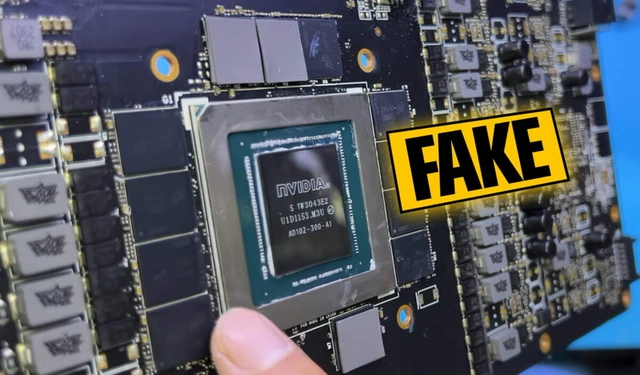
At first glance, the printed circuit board (PCB) appeared standard. The GPU die bore a confident marking—Nvidia AD102-300-A1—along with the code TW304E2. Yet, a granular analysis revealed glaring errors that only a specialist would notice. The date code "30" explicitly suggested the chip was manufactured in 2030, rendering its existence in the present day a physical impossibility.
Beyond this temporal paradox, the card exhibited a complete disregard for authenticity. The mandatory QR code was missing from the lower-left corner of the GPU substrate, and the arrangement of surrounding SMD components—the minute capacitors and resistors—bore no resemblance to the actual RTX 4090 circuitry.
The most shocking revelation concerned the material of the "processor" itself. Closer inspection revealed that the central component, which should have been a complex silicon die housing billions of transistors, was made of ordinary plastic. This polymer surrogate had simply been etched with imitation markings to create the illusion of a high-end chip.
The deception was absolute: even the GDDR6X memory modules surrounding the GPU were fakes. These empty shells were soldered onto the board solely to ensure the device looked complete and could pass a superficial visual inspection.
This case marks a distinct evolution in the ecosystem of "grey markets." Previously, scammers employed more labor-intensive methods: for example, repurposing old GA102 chips from the RTX 3080 or 3090, laser-stripping the original markings, and applying new labels to pass the card off as a modern model. There were even cruder iterations where cards were sold with entirely empty GPU sockets.
The shift toward plastic imitations indicates that counterfeiters are no longer betting on partial functionality or the ability to deceive software benchmarks, but on pure visual simulation. This transforms the "hardware" into a mere mockup—incapable of performing any computational tasks, yet designed to deceive an unsuspecting buyer at the point of sale.
 The Economic Paradox of the GeForce RTX 5090