Modern high-speed interfaces inevitably hit a physical ceiling—signal attenuation—as cable lengths increase. Traditionally, the industry has countered this challenge either through the integration of costly active repeaters or by enforcing strict distance limitations. The emergence of a fully passive nine-meter USB4 solution is now redefining the conventional approach to workspace and professional studio architecture. At the heart of this engineering trade-off is a calculated decision: sacrificing peak throughput in exchange for exceptional connectivity flexibility.
Data transmission over significant distances has always been the Achilles' heel of USB standards. Due to the inherent physical properties of copper and electromagnetic interference, passive USB 3 or USB4 cables are typically restricted to very short lengths; otherwise, signal degradation renders data transfer unstable. To overcome this barrier, manufacturers employ active cables with integrated repeater chips that amplify the signal—though this increases both cost and manufacturing complexity.
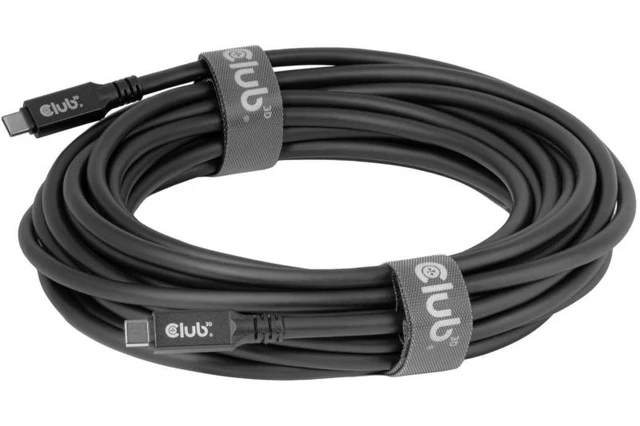
Club 3D has proposed a novel alternative with the release of the CAC-2509: the first fully passive USB4 cable reaching nine meters in length. The engineers achieved this distance without active amplification by implementing a calculated trade-off: rather than pushing for the standard's maximum 40 or 80 Gbps, the cable's throughput is capped at 20 Gbps.
This solution leverages the inherent flexibility of the USB4 protocol, which can dynamically allocate data streams and various protocols across a shared high-speed channel. However, real-world functionality is always dictated by the weakest link in the chain—be it the cable itself, the host device, or the peripheral. In this instance, limiting the speed to 20 Gbps is the price paid for the ability to separate a computer and monitor by a significant distance without sacrificing connection stability.
The most promising use case for such a cable is the creation of a unified workstation where a single wire handles video signals, USB hub functionality, and laptop power delivery simultaneously. Despite the reduced overall speed, the CAC-2509 can support 8K resolution at 60 Hz or 4K at 240 Hz. Achieving these parameters requires DisplayPort Alt Mode support and, in most cases, the use of Display Stream Compression (DSC) algorithms. For example, driving a 5K display at 60 Hz requires only about 7 Gbps, which comfortably fits within the cable's capabilities.
A similarly pragmatic approach was applied to power delivery. The cable supports up to 100W—significantly less than the modern Extended Power Range (EPR) standard, which allows for up to 240W. Nevertheless, for the vast majority of modern ultrabooks, professional monitors, and docking stations, a 100W limit is more than sufficient. High-performance gaming rigs with massive power supplies remain the exception, as they require a dedicated power source regardless.
Ultimately, Club 3D has created a tool for specialized yet high-demand applications. A nine-meter cable opens new possibilities for equipping conference rooms, building complex racing simulators, or organizing remote workstations where the system unit is housed in a separate cabinet or across the room. Priced at €82, this product serves as an accessible solution for those who prioritize cable length over theoretical peak throughput.
 Breaking the Lithography Barrier in China