Deep space exploration currently faces a singular, critical bottleneck: propellant logistics. While ambitious private ventures strive to master orbital refueling, the fluid dynamics of transferring cryogenic liquids in microgravity remain among the most daunting engineering hurdles of the modern era. Recognizing the strategic risks of relying on a single contractor, NASA is developing its own autonomous resource transfer system. This strategic pivot is designed to safeguard the success of future lunar and Martian missions, insulating them from the fluctuating development timelines of commercial platforms.
Contemporary blueprints for returning humans to the Moon and the subsequent leap toward Mars necessitate a fundamental paradigm shift in space logistics. The Starship system exemplifies this challenge: reaching target destinations and landing a crew will require a staggering volume of propellant, which in turn makes up to fifteen consecutive orbital refuels a necessity. However, the technology for transferring cryogenic fluids in microgravity remains theoretically sound but practically unproven in operational environments.
The complexity of the task lies in the inherent volatility of cryogenic propellants. At extreme sub-zero temperatures, liquid oxygen and hydrogen behave erratically; any temperature fluctuation triggers significant thermal contraction of materials, while the absence of gravity turns the process of separating liquid from gas within the tanks into an engineering nightmare.
Legacy methodologies, utilized for decades at launch sites, are rendered obsolete in this context. For instance, the coupling devices used to fuel the SLS rocket for the Artemis program are designed strictly for terrestrial conditions. They are cumbersome, require manual connection, and are intended for single use prior to launch. In the vacuum of space, such mechanisms are not only prohibitively heavy but entirely non-functional, as their operation would demand frequent and perilous extravehicular activities (EVAs) by astronauts.
In response to these challenges, NASA, in collaboration with L3Harris engineers, is developing a fundamentally new class of interfaces: automated cryogenic couplings. Unlike their ground-based counterparts, these devices are engineered as reusable, fully autonomous systems. The primary objective is to create a mechanism capable of independently docking with spacecraft reservoirs, ensuring the hermetic transfer of fuel without human intervention. These systems must be compact and exceptionally resilient to the extreme stresses characteristic of orbital maneuvers.
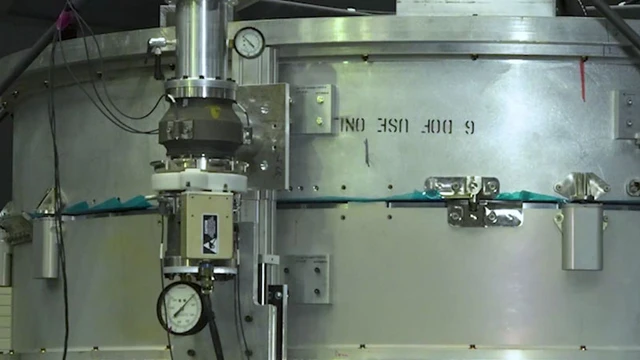
To validate the viability of this concept, a series of stringent tests were conducted. To simulate the conditions of deep space, liquid nitrogen—which drops to –196°C—was cycled through the coupling nodes. The engineers were less concerned with the mere movement of the fluid and more focused on the materials' reaction to extreme thermal shock. The research centered on how the connection behaves under abrupt contraction and the stability of the cryogenic flow amidst critical temperature differentials between the propellant and the device housing.
While development is currently in its nascent stage and tests are focused on confirming basic functionality, the creation of a proprietary, independent refueling standard ensures that NASA is not solely reliant on commercial third-party solutions. In the future, these cryogenic couplings will be tailored to the specific requirements of each mission, transforming orbital refueling from a high-risk experiment into a standard operational procedure—effectively paving the way for humanity's journey into deep space.
 Taiwan's Space Program: The First Major Milestone