The global pursuit of smaller process nodes in the semiconductor industry is no longer just a battle of chemistry and electronics; it has reached the fundamental boundaries of optical physics. Scaling the production of cutting-edge chips is now inextricably linked to the capacity to engineer optical systems with a level of precision once thought impossible. Within this critical supply chain, Zeiss SMT serves as the sole technological gatekeeper, effectively dictating the pace of advancement for the entire field of lithography. Consequently, expanding manufacturing capacity within Germany has evolved into a mission-critical imperative for the survival and viability of the entire EUV scanner ecosystem.
The contemporary microelectronics market exists in a state of acute dependence on a single, narrow bottleneck: the capacity of Zeiss SMT to deliver ultra-complex optical components. Without the lenses, mirrors, and illumination systems provided by this German giant, the production of ASML's EUV scanners becomes physically impossible. Recognizing this systemic risk, Zeiss has commenced operations at a new production complex in Oberkochen, designed to eliminate this "technological congestion" and scale up equipment output.
The symbiosis between ASML and Zeiss has evolved beyond a standard partnership into a strategic alliance, where financial flows mirror the sheer scale of the industry's ambitions. Procurement volumes for optical systems are seeing exponential growth: rising from €3.33 billion in 2023 to a projected €4.41 billion by 2025. To guarantee supply chain stability, ASML is effectively investing in its supplier's infrastructure through multi-billion euro loans and advance payments for future optical columns.
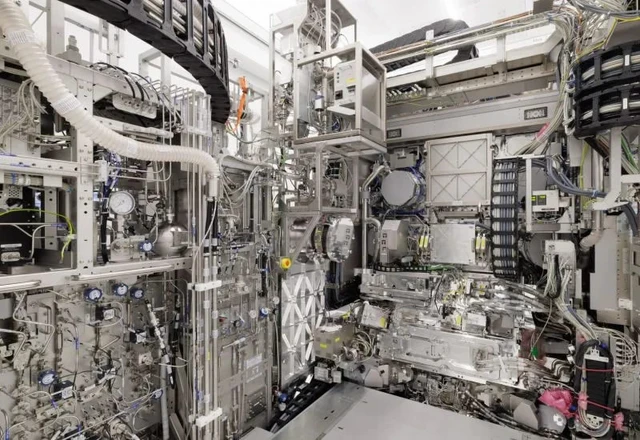
However, expanding physical footprints does not automatically translate into increased throughput. Engineering optics for High-NA EUV systems represents one of the most formidable technical challenges in human history. We are talking about systems where a single projection unit consists of over 40,000 individual parts and weighs approximately 12 tons. The illumination system adds another 25,000 components to this complexity.
Particular emphasis is placed on the mirrors, whose production requires months of meticulous craftsmanship. Following fabrication, every element undergoes verification in a colossal vacuum chamber weighing over 150 tons and comprising 100,000 parts. Such extreme precision is mandatory to ensure that light with an ultra-short wavelength can be focused with atomic-level accuracy.
Parallel to these technical refinements, Zeiss SMT is optimizing its operational workflows. ASML's executive leadership has set ambitious targets: increasing system output by approximately 30% and radically compressing the assembly cycle for each scanner—reducing it from 22 weeks down to 15–16. This objective requires more than just new facilities in Oberkochen; it demands a comprehensive overhaul of the entire supporting infrastructure.
Zeiss’s expansion strategy extends far beyond a single city. The company is scaling its plant in Wetzlar, modernizing cleanrooms in Rosdorf, and establishing an innovation center in South Korea to maintain proximity to the world's largest semiconductor consumers. A 23% surge in divisional revenue to €5.055 billion confirms that the demand for high-precision optics will only intensify, cementing Zeiss SMT as a fundamental pillar upon which all modern computing power rests.
 AMD’s Strategic Approach to the Budget Segment