The exponential surge in AI compute power is pushing modern data center infrastructure to its absolute physical limits. Power consumption and water scarcity have emerged as critical bottlenecks, threatening the scalability of massive compute clusters. In response, Nvidia is proposing a radical paradigm shift in thermal management, moving away from the traditional obsession with maximizing cooling. The implementation of "warm" liquid cooling systems for the Rubin generation is designed to decouple performance gains from environmental degradation.
The contemporary data center landscape is grappling with a fundamental paradox: as chips become more powerful, an increasing share of resources is spent not on computation itself, but on mitigating its primary byproduct—excess heat. Traditional water-cooling methods, heavily reliant on industrial chillers, have evolved into one of the industry's primary cost drivers. In some instances, cooling systems consume up to 40% of a facility's total power, placing an immense strain on energy grids and resulting in significant water loss through evaporation.
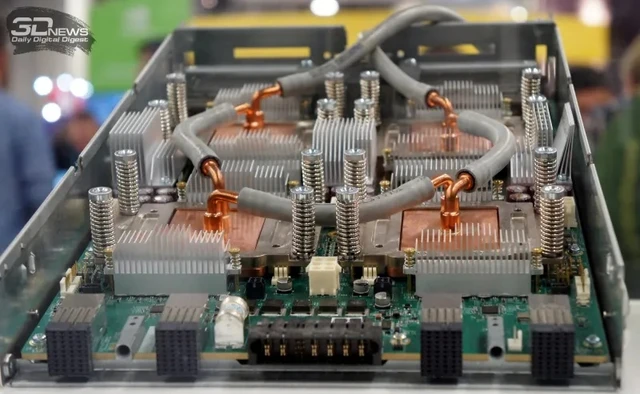
Nvidia is challenging this status quo with a solution that, at first glance, seems counterintuitive. Rather than attempting to maximize the cooling of the heat transfer fluid, the company is pivoting toward the use of "warm" liquids. The new system utilizes a mixture of 75% water and 25% propylene glycol, with the baseline fluid temperature maintained at 45°C.
From the perspective of conventional engineering, such a temperature appears high; however, in the context of the new Rubin series chips, it is optimal. The critical factor here is the thermal gradient: since Rubin dies are engineered to operate efficiently at 55°C, a coolant temperature of 45°C is sufficient to effectively dissipate heat. This shift allows operators to almost entirely eliminate power-hungry chillers across most operational scenarios.
The fiscal implications of this temperature shift are profound. According to industry estimates, raising the target installation temperature by just 1°C reduces energy costs by approximately 4%. Moving from the standard 21–24°C range to Nvidia’s recommended 45°C offers data center operators a path to radically slash operational expenditures (OpEx) and significantly shrink their carbon footprint.
Beyond energy efficiency, this approach addresses the critical issue of water consumption. Nvidia is moving toward a fully closed-loop system: the infrastructure is filled once and operates without the need for refills or evaporation losses throughout the facility's lifespan. This makes the technology exceptionally attractive for cold-climate regions, where ambient air cooling can replace active systems entirely. In warmer zones, efficiency is maintained as long as the ambient temperature remains below the 45°C threshold—only in such exceptional cases would auxiliary chillers need to be activated.
The deployment of this technology could provide a vital answer to the systemic bottleneck in capacity deployment. Currently, more than 75 data centers worldwide have faced launch delays specifically because they cannot provide the requisite cooling levels for ultra-high-power GPUs.
Nevertheless, the transition to "warm" cooling will not happen overnight. Integrating such systems into existing projects requires a fundamental redesign of the engineering infrastructure. Furthermore, this optimization is strictly tied to the specifications of the Rubin chips. Previous and current generations of GPUs will continue to demand massive resources for heat dissipation, ensuring that the shift to these new standards will be an incremental evolution of the entire high-performance computing (HPC) ecosystem.
 The Economic Paradox of the GeForce RTX 5090