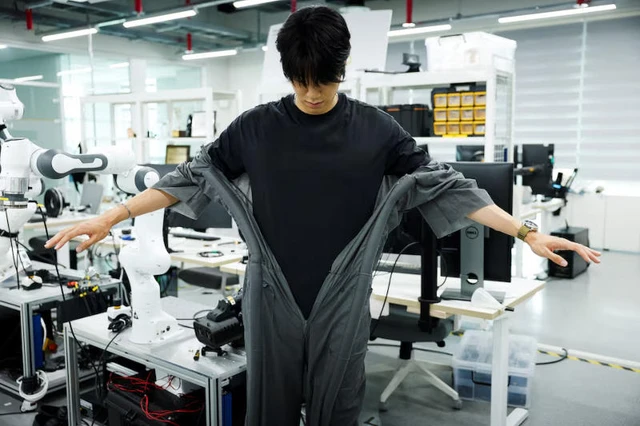
The act of dressing may seem trivial, yet for millions living with disabilities or professionals operating within sterile environments, it represents a formidable barrier. Cutting-edge soft robotics is now bridging this gap, evolving clothing from a passive garment into an active mechanism. A collaborative effort between engineers from South Korea and the United States has yielded a system capable of autonomously conforming to the human physique without external assistance. This breakthrough paves the way toward total physical autonomy, even within the most demanding operational environments.
The core of this concept is a fundamental transition from rigid manipulators toward the principles of soft robotics. In place of conventional servo drives and metallic joints, the system employs flexible pneumatic structures that mimic the organic behavior of climbing vines. Integrated directly into the fabric and actuated by air pressure, these elements allow the garment to literally "mold" itself around the human form.
The system’s technical ingenuity lies in its method of locomotion: rather than simply sliding across the skin, the robotic vine advances by inverting its own structure. This process ensures exceptional stability when navigating the complex contours of human anatomy, even while the subject remains stationary. Consequently, the entire donning cycle is completed in just ten seconds, rendering the technology nearly seamless and highly efficient.
A pivotal engineering breakthrough was the implementation of expanding elements over traditional articulated joints. This allows the system to maintain stability across any surface—be it smooth skin, adhesive materials, or irregular textures. The mechanism's ability to penetrate narrow spaces and dynamically adapt to body morphology makes it a universal tool, eliminating the need for bespoke tailoring or pre-calibration to specific user parameters.
The applications of this technology extend far beyond mere domestic convenience. In the industrial sector, such suits will become indispensable in semiconductor fabrication, where stringent "clean room" protocols prohibit unnecessary movement and minimize contamination risks. In critical scenarios, robotic apparel would enable first responders to gear up instantaneously within hazardous zones, removing the friction of routine manual preparation.
The development holds particular significance for medicine and social integration. For individuals with severe motor impairments or the elderly, the ability to dress independently represents a restoration of basic dignity and autonomy. Ultimately, the convergence of textiles and pneumatics transforms ordinary clothing into an intelligent interface that assumes the physical burden of interacting with the human body.
 Breakthrough in the Mass Production of Solid-State Batteries