The boundary between biological intent and mechanical execution is increasingly blurring. For those grappling with severe paralysis, the loss of mobility represents more than a mere physical constraint; it is a profound erosion of personal autonomy. Recent demonstrations from Neuralink signal a path toward reclaiming this independence through direct brain-computer interfaces (BCIs). By synthesizing neural impulses into digital commands, the technology effectively translates raw thought into tangible physical action.
Contemporary neurotechnology is tackling one of medicine's most formidable challenges: restoring the severed link between the brain's cognitive command center and the body's executive mechanisms. At the heart of this effort lies the N1 intracranial implant, a high-fidelity bridge designed for precision neural interfacing. The device features 1,024 electrodes distributed across 64 flexible threads, each thinner than a human hair. To minimize tissue trauma and ensure surgical precision, the implant is deployed via a robotic surgical system that integrates the threads directly into the motor cortex—the region of the brain responsible for planning and executing voluntary movement.
The system operates by recording the electrical activity of neurons. When a user imagines moving their arm or shifting a cursor across a screen, specific clusters of cells generate distinct impulse patterns. The implant captures these signals and transmits them via a wireless channel to a computational decoder. Here, machine learning algorithms interpret the inherent biological noise in real-time, translating neural spikes into precise digital coordinates.
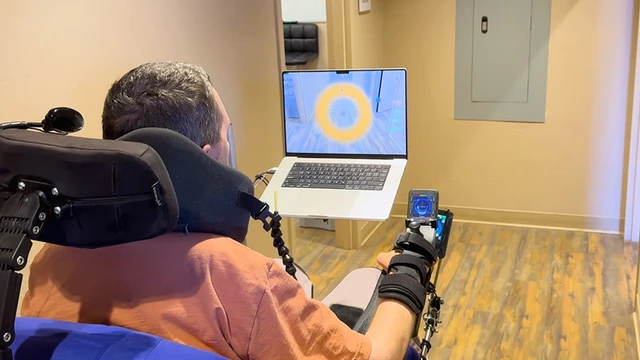
A critical technical nuance of the wheelchair control system is that the brain's signal does not drive the motors directly. Instead, it operates through a virtual control layer: the user effectively manipulates a cursor on a screen displaying a feed from a camera mounted on the chair. Moving the pointer upward triggers forward motion, downward for reverse, and lateral shifts for steering. The velocity is determined by the amplitude of the cursor's displacement from the center point. Once the command signal ceases, the system automatically centers the pointer, resulting in a smooth deceleration and a complete halt of the device.
This architecture allows the control functionality to extend beyond simple locomotion. A dedicated electronic module converts cursor coordinates into commands for various actuators, enabling the user to adjust seat positioning and backrest inclination. In this capacity, the brain-computer interface (BCI) evolves into a comprehensive command hub for the user's entire ergonomic environment.
Practical data from test participants indicates that the adaptation process is remarkably rapid. While initial attempts are often characterized by jerky, uncoordinated movements, the brain adapts to the new feedback loop within minutes, and the motions become intuitive. Moving beyond the traditional joystick not only restores mobility but significantly enhances physical comfort, freeing up space and allowing for a more ergonomic posture.
Despite these impressive results, the technology remains in the experimental phase. The product has yet to undergo full-scale clinical trials, and a rigorous path of safety and reliability verification lies ahead before mass adoption is possible. Nevertheless, the transition from controlling a virtual cursor to the direct manipulation of physical objects marks a pivotal shift in the rehabilitation paradigm, transforming the dream of full autonomy into an achievable engineering objective.
 The Triumph of 3nm Chip Manufacturing