The line between biological failure and technological restoration is blurring. For years, brain-computer interfaces (BCIs) were confined to the realm of digital interaction—tasks such as controlling a cursor or synthesizing speech. However, a pioneering approach to neural bypassing is shifting these capabilities from the abstract plane of virtual commands into the reality of physical motion. A successful experiment in restoring limb motor function marks the beginning of a new chapter in the rehabilitation of patients suffering from profound paralysis.
For years, the prevailing paradigm in neurobiology treated implants merely as intermediaries—translators that interpreted brain impulses to operate external devices. However, recent breakthroughs in neuroprosthetics are shifting the focus from simple command synthesis toward direct intervention in the human muscular system. The goal is the creation of an artificial signal pathway that effectively bypasses damaged sections of the nervous system, restoring a patient's agency over their own body.
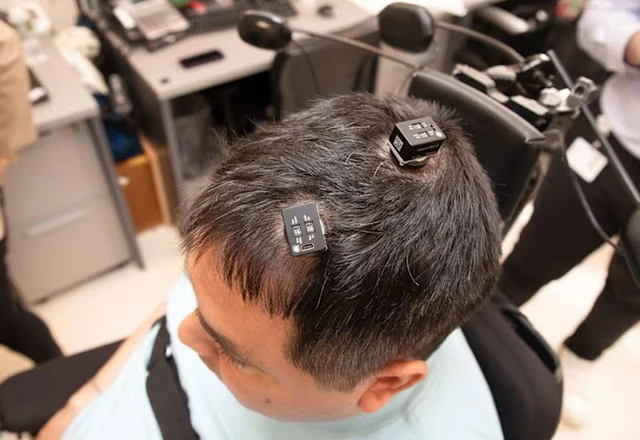
This technological leap was achieved through a method known as double neural shunting. In a complex, multi-hour surgical procedure, a patient with tetraplegia was fitted with two brain implants, each equipped with five electrode arrays. This system operates in tandem with cutaneous sensors on the upper limbs, which convert neural signals into electrical stimuli for the muscles. In this architecture, the computer serves as an intelligent conduit, bridging the severed connection between the intention to move and its physical execution.
The linchpin of the system is a suite of machine learning algorithms. These tools were essential in calibrating the interaction between stochastic brain impulses and specific muscle contractions. The results were striking: over a 35-week observation period, the patient recovered 86% of muscle tone in the right arm and 62% in the left. This progress enabled the patient to return to basic activities of daily living, such as self-feeding, and to perform complex coordinated tasks requiring the simultaneous use of both hands.
Yet, the true significance of this research lies not only in motor recovery but in the establishment of a comprehensive feedback loop. In a healthy state, the brain receives data regarding grip strength or object positioning via sensory receptors; in cases of paralysis, this link is severed. To address this, researchers developed a specialized sensor that measures the force applied during an object's grasp and transmits this data back to the brain.
Such sensory integration is critical for the development of fine motor skills. The system's efficacy was empirically validated through a test involving fragile objects: in 87% of attempts, the patient successfully grasped raw eggs without crushing them. This ability to precisely modulate force demonstrates that artificial feedback can effectively mimic proprioception—the innate sense of one's own body in space.
While motor recovery proved more pronounced than sensory restoration, the experiment validates the viability of the neural shunt concept. It establishes a rigorous foundation for future rehabilitative developments, where the objective is no longer merely controlling a prosthetic or a cursor, but the full restoration of biological limb functionality.
 Nvidia N1X and the New Era of Arm PCs