The boundary between digital code and physical matter is increasingly dissolving. Modern Large Language Models are evolving beyond the role of mere textual assistants, transforming into full-fledged design engineers. A case study on the creation of a cluster using Framework modular boards illustrates a new frontier in the integration of AI within industrial design. Today, the trajectory from conceptual spark to a production-ready STL file can be navigated with virtually no direct human intervention.
The era when artificial intelligence was confined to generating text and images is rapidly receding. A new frontier has emerged: the direct interaction between neural networks and engineering software to create tangible physical objects. A prime example of this synergy is a project to develop a chassis for a compute cluster built around three Framework laptop motherboards.
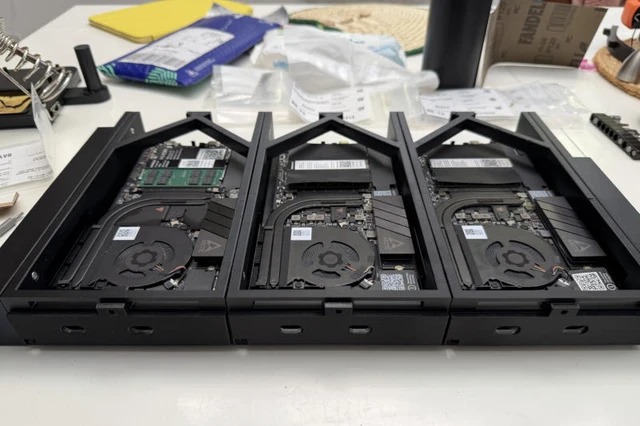
The choice of the Framework platform was deliberate; the brand's core philosophy of modularity and the right to repair makes its boards an ideal "construction kit" for building custom servers or multi-node systems. The objective was to engineer an optimal frame capable of integrating three 13-inch boards into a single, cohesive functional unit.
The technical execution relies on the Model Context Protocol (MCP)—an open standard that enables large language models to interface with third-party software. In this instance, Claude was integrated with Autodesk Fusion 360, a professional CAD system. This transition evolved the AI from a mere advisor into an active operator of the design environment, capable of generating full project files and exporting them as STL files ready for additive manufacturing.
The development process functioned as a dynamic workflow: the neural network did not simply suggest ideas but actively shaped the geometry of the components. The final design accounted for critical engineering requirements, incorporating specialized cutouts for heatsinks and dedicated space for heat pipes—essential considerations when packing several high-performance boards into a compact enclosure.
Despite the system's high level of autonomy, the path to the final product was not linear. Achieving industrial-grade quality required several iterative cycles with the model to refine tolerances and part interfaces. Nevertheless, the "prompt-to-print" concept was successfully realized: the AI handled not only the design but also the generation of the bill of materials for procurement.
This experiment raises a pivotal question about the future of engineering. We are witnessing a shift toward a paradigm where the human acts as curator and validator, while the rote work of 3D modeling is delegated to algorithms. However, the primary challenge for such systems remains physical verification; calculating thermal profiles and verifying actual cooling efficiency in dense clusters still demands deep expert evaluation—a role AI cannot yet fully assume.
 The Horizon of China's Technological Sovereignty in Lithography