The era of cloud computing is increasingly being augmented by a shift toward the local execution of resource-intensive neural networks. Today's enterprises and developers demand tools capable of processing massive datasets without the need to transmit sensitive information to external servers. Honor’s new Tiangong AXB35 workstation series pursues an ambitious objective: packing the performance of a full-scale server into a compact two-liter chassis. This approach paves the way for deploying sophisticated multi-agent systems directly on the desktop.
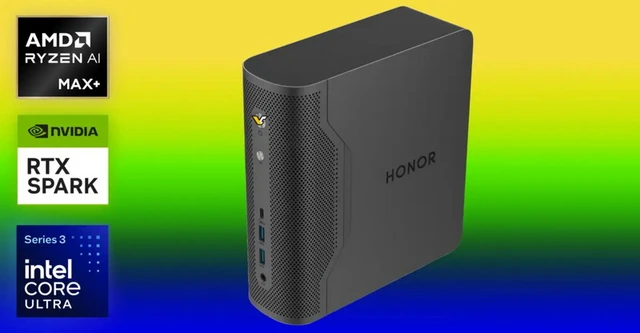
The personal computing landscape is undergoing a fundamental shift, where traditional clock speeds are yielding to tensor processing power. The Tiangong AXB35 lineup is a direct response to this evolution, offering a mini-PC form factor that aspires to the capabilities of professional workstations. The entire series shares a sleek, minimalist chassis measuring 70 × 192 × 203 mm and weighing approximately 1.5 kg, ensuring portability without compromising its formidable internal potential.
The flagship AXB35 Ultra is built upon the Nvidia RTX Spark platform, which functions as a hybrid solution. At its core lies a combination of a GPU based on the cutting-edge Blackwell microarchitecture and a 20-core Grace CPU powered by Arm. The defining advantage here is 128 GB of LPDDR5X unified memory. In the context of Large Language Models (LLMs), unified memory is critical; it eliminates the data bottleneck between the CPU and GPU, enabling significantly more efficient processing of massive datasets.
The technical capabilities of the Ultra version are impressive: AI performance reaches 1 Petaflop when utilizing the FP4 format. This level of computational precision optimizes neural network operations while maintaining high processing speeds. According to the developers, the system can support models with up to 300 billion parameters. Naturally, real-world performance will depend on the degree of weight quantization, the length of the context window, and the efficiency of the software stack. However, the mere fact that such giants can run on a 2-liter device elevates local AI to an entirely new level.
To ensure stability under such heavy workloads, three power profiles are provided: 55W, 85W, and 132W. Power is delivered via an external 240W adapter, which offloads excess heat generation from the internal chassis and optimizes the cooling system.
Beyond the extreme Ultra version, the AXB35 series includes Standard and Pro configurations tailored for broader applications. The Standard version is powered by the Intel Core Ultra X7 358H with 64 GB of RAM, delivering performance at the 180 TOPS level. The Pro model utilizes the AMD Ryzen AI Max+ 395 chip, features 128 GB of RAM, and demonstrates a rating of 126 TOPS. The differing approaches of Intel and AMD toward Neural Processing Unit (NPU) implementation allow users to choose the level of optimization best suited for their specific automation and data analysis tasks.
The connectivity suite of these workstations is engineered for professional use. Dual 10 Gbps Ethernet ports and Wi-Fi 7 support guarantee high-speed data exchange within local networks—a necessity when working with distributed systems. The I/O array includes two USB4 ports, four USB-A ports, as well as modern HDMI 2.1 and DisplayPort 1.4 video outputs. For those requiring more than the base storage, three M.2 slots are provided, allowing for significant expansion of permanent memory.
Software versatility is ensured by support for both Windows 11 and Ubuntu, making these stations fully capable tools for developers accustomed to the Linux ecosystem. While precise release dates and pricing remain undisclosed, the Tiangong AXB35 signals a clear trajectory: migrating heavy computational tasks from remote server farms to local devices while maintaining a minimal physical footprint on the desktop.
 Breaking the Lithography Barrier in China