The primary hurdle facing the evolution of quantum computing today is scalability; the pursuit of a single monolithic processor boasting thousands of qubits has proven technically prohibitive. As an alternative, the industry is shifting toward distributed architectures, where independent modules are networked through dedicated quantum communication channels. A recent technological milestone has finally realized remote entanglement between nodes—a capability that remained purely theoretical for two decades. This breakthrough fundamentally simplifies state synchronization, paving the way for the emergence of modular quantum supercomputers.
Quantum entanglement is a fundamental phenomenon that Albert Einstein once skeptically dismissed as "spooky action at a distance." At its core lies a profound correlation between particles: a change in the state of one qubit is instantaneously reflected in another, regardless of the physical distance separating them. In modern quantum informatics, this is far more than a theoretical curiosity; it is the primary resource driving an exponential leap in computational power over classical systems.
Until now, entangling remote qubits has been a meticulous process characterized by extreme complexity. Traditional methods relied either on the transmission of a strictly controlled single photon between nodes or the use of beam splitters where two photons collided and were detected to verify the operation's success. Both scenarios demanded intricate feedback loops, constant measurement, and precision real-time parameter correction, rendering the systems fragile and highly susceptible to error.
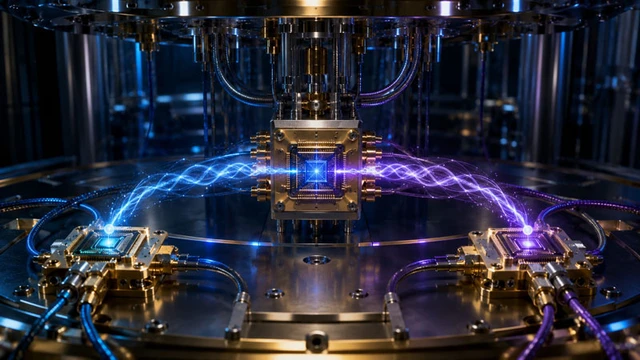
A new approach, recently demonstrated by physicists, shifts the paradigm from active control toward environmental engineering. Rather than attempting to "link" qubits manually, researchers immersed them in a shared stream of specially prepared microwave radiation. This is akin to placing objects into the same bath: the external environment itself induces the required state, eliminating the need for constant monitoring and adjustment.
Technically, the solution leveraged superconducting qubits based on Josephson junctions. The centerpiece was a Josephson parametric converter, which generated pairs of correlated microwave signals. These signals were delivered to the qubits via separate cables; because the entanglement already existed within the radiation itself, it was effectively transferred from the field to the matter. In essence, the state of the microwave stream served as a template for synchronizing remote particles.
The dynamics are impressive: the entangled state formed in approximately 300 nanoseconds and persisted for 10 microseconds—exactly the duration of the radiation stream. This is a critical detail, as the external signal did not merely establish a one-time connection but acted as a stabilizer maintaining system coherence. However, current efficiency remains limited; the qubits captured only about ten percent of the quantum correlation present in the original stream, primarily due to signal loss during transmission and imperfections in the hardware components.
In the long term, this technology lays the groundwork for distributed quantum networks. Instead of attempting to build a single, monolithic cryostat housing a massive number of qubits, the industry can move toward a modular architecture. Multiple compact quantum processors could be linked via shared streams of entangled photons, allowing the system to scale almost indefinitely.
Full-scale practical implementation will require solving two fundamental challenges: minimizing transmission losses in communication channels and developing efficient transducers to convert microwave photons into optical ones. The latter is essential for transmitting quantum information over standard fiber-optic lines across significant distances, evolving local experiments into a global quantum network.
 The Phenomenon of Chinese 96GB AI Accelerators