For decades, modern cosmology has rested on the premise that dark matter serves as the fundamental "scaffolding" of the universe. Under this paradigm, invisible concentrations of this substance created the gravitational wells necessary to trap gas, ultimately igniting the birth of stars and the assembly of entire galactic systems. However, recent astronomical data are challenging this dogma, uncovering objects that evolve in defiance of established rules. The discovery of galaxies devoid of dark matter halos is now compelling scientists to fundamentally rethink the mechanisms driving the formation of the cosmos's large-scale structures.
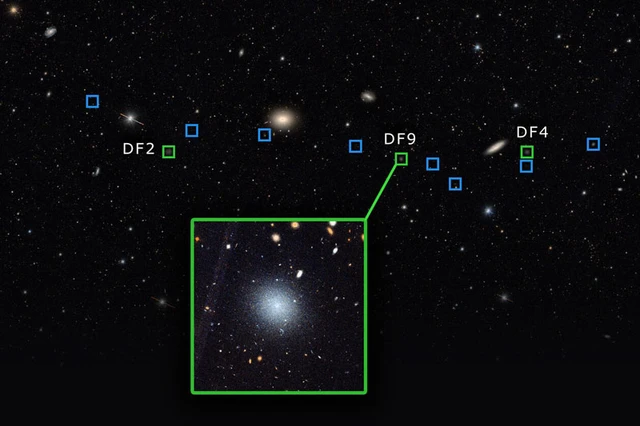
Within the scientific community, an unspoken axiom prevails: a single occurrence is an anomaly, two are a coincidence, but three constitute a pattern. It is through this lens that we must view the latest discoveries in extragalactic astronomy. Following the detection of two enigmatic objects—DF2 and DF4—which exhibited virtually no signs of dark matter, researchers have identified a third similar system: NGC 1052-DF9 (DF9).
Intriguingly, these three galaxies are aligned along a similar trajectory and situated at a comparable distance from Earth—approximately 70 million light-years. Such spatial correlation suggests that their unusual nature is not a random glitch, but rather the result of shared physical processes that occurred within this specific sector of space.
To decode these anomalies, researchers turned to computational modeling. The results suggest that these diffuse galaxies may have originally possessed standard dark matter halos. However, their progenitors likely collided at colossal velocities in the distant past. During this catastrophic event, the dark matter—which interacts only weakly with ordinary matter—was effectively "stripped" from the systems, continuing its trajectory by sheer inertia.
Conversely, interstellar gas, characterized by its viscosity and capacity for interaction, decelerated and coalesced. This allowed baryonic matter to collapse and form stars even in the absence of the gravitational scaffolding typically provided by a dark halo. Consequently, we are observing "stripped" galaxies that managed to survive and evolve independently.
The verification of this phenomenon rests on a rigorous comparison between visible and dynamical mass. Observations of stellar dynamics within NGC 1052-DF9 allowed scientists to calculate the object's total mass at approximately 100 million solar masses. This figure aligns almost perfectly with the mass of the visible matter alone. Had the galaxy possessed a typical dark matter halo, its total mass would have reached 10 billion solar masses. Such a staggering discrepancy renders the absence of dark matter an indisputable fact, as its presence would have inevitably altered stellar orbits and the gravitational influence on neighboring objects.
From a theoretical standpoint, this conclusion carries weight far beyond the mere existence of "empty" galaxies. The fact that dark matter can be decoupled from ordinary matter and exist independently serves as a powerful argument that it is a physical substance (composed of particles) rather than a byproduct of our incomplete understanding of gravitational laws at galactic scales.
This discovery imposes stringent constraints on the theoretical properties of dark matter and brings humanity closer to unraveling the nature of the universe's most mysterious component. The continued search for and study of such objects may trigger a fundamental shift in our understanding of the cosmic hierarchy.
 SpaceX’s Hundred-Billion Dollar Leap into Louisiana