The era of specialized gaming hardware often exposes a rift between corporate vision and real-world user ergonomics. Valve’s ambition to transform the living room into a comprehensive gaming hub via the Steam Machine was a bold experiment—one that, however, left several critical details unresolved. Today, the enthusiast community continues to evolve these systems, reimagining purely aesthetic elements as utilitarian assets. A recent front-panel modification project demonstrates exactly how the precision of CAD engineering and 3D printing can solve the persistent challenge of peripheral charging.
The trajectory of the Steam Machine's development was defined by Valve's pursuit of modularity. The company even showcased concepts for interchangeable front panels featuring e-ink displays designed to surface system information and notifications. In practice, however, this vision stumbled over a fundamental hardware limitation: viewing angles. E-ink screens are notoriously difficult to read when the device is positioned in a standard desktop orientation, rendering them largely ineffective for daily utility.
To address this engineering shortfall, an alternative approach was developed—one where aesthetics yield to pure functionality. Rather than attempting to integrate an information display, the focus shifted toward solving one of the most persistent pain points for Steam Controller owners: the ergonomics of charging and storage.
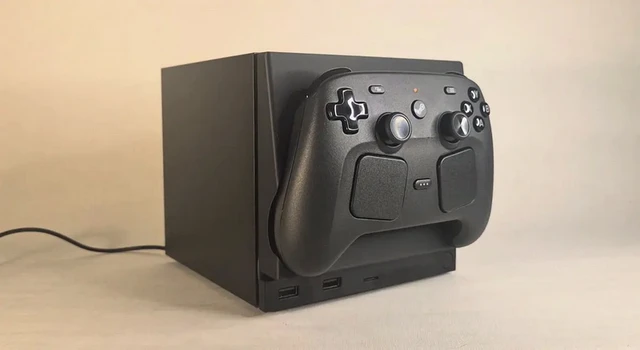
The resulting custom panel is more than a mere decorative bezel; it is a fully realized docking station. An integrated magnetic charger ensures the controller snaps into precision-engineered slots tailored to its exact geometry. This transforms the front of the chassis into an organized storage hub, effectively eliminating cable clutter from the workspace.
The technical execution of the project is rooted in open-source principles, leveraging official CAD files released by Valve. Developed within Fusion, the design ensures seamless compatibility with the Steam Machine's chassis. For the physical build, 3D printing was employed using Bambu Lab Matte Charcoal filament, chosen for its ability to closely mimic the texture and hue of the original factory materials.
The attention to cable management is particularly noteworthy. The charger's USB cable is routed along the perimeter of the system and connected to a rear port, remaining virtually invisible to the observer. Furthermore, the module maintains a degree of autonomy: a detachable stand allows the panel to function as a standalone charging station even when removed from the PC chassis.
This approach to modification breathes new life into legacy hardware, demonstrating how precise engineering and accessible manufacturing technologies can empower users to rectify industrial design oversights on their own terms.
 The Price of Acceleration: CXMT’s Rapid Push into Memory