The global semiconductor market has long been mired in turbulence, with component availability serving as the primary governor of technological progress. NAND flash memory and SSDs remain critical bottlenecks, throttling growth across both consumer and enterprise segments. However, TrendForce analysts foresee a definitive stabilization horizon by 2027. This period is poised to be the inflection point where supply finally synchronizes with demand, effectively closing the chapter on an era of acute shortages.
The NAND flash market is currently grappling with a prolonged resource crisis, where the demand for SSDs and flash memory chips significantly outstrips production capacity. According to forecasts from TrendForce, this tension is expected to persist through the end of 2026. A moderate deficit—estimated between 4% and 6%—is anticipated in the first half of next year, signaling a gradual, albeit slow, progression toward market equilibrium. Full restoration of supply chains and a definitive end to the shortage are not projected until the second half of 2027.
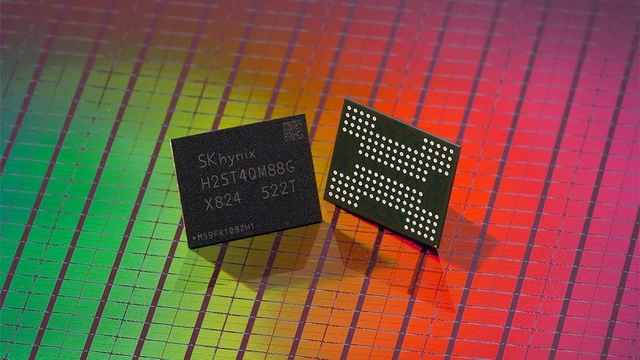
This stabilization is no coincidence; it is underpinned by a massive overhaul of production capacities by industry titans such as Samsung, Micron, and SK hynix. This shift involves more than just increasing monthly silicon wafer throughput; it represents a profound technological transformation of manufacturing processes. In the NAND industry, this translates to a transition toward higher cell density within multi-layer structures (3D NAND), allowing for a substantial increase in memory capacity per unit of die area, thereby stabilizing supply after a protracted period of volatility.
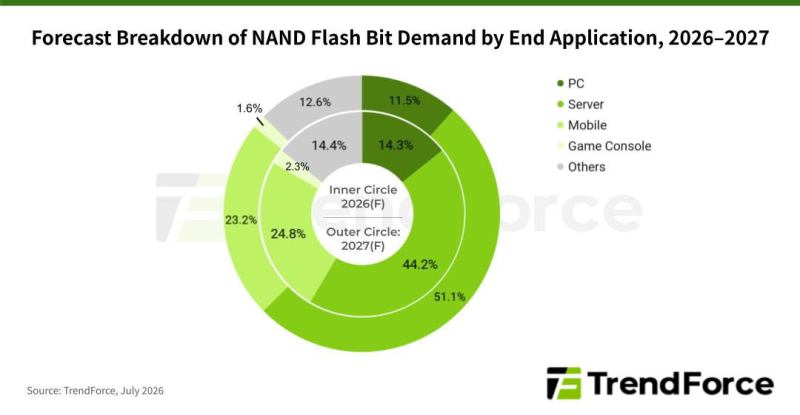
In a paradoxical twist, one of the primary catalysts for recovery has been a slump in consumer demand. The sharp spike in electronics pricing, driven by DRAM and NAND Flash shortages, led end-users to defer hardware upgrades to avoid inflated premiums. Conversely, the enterprise sector is exhibiting opposite dynamics: the expansion of cloud infrastructure and the proliferation of artificial intelligence have positioned servers as the primary consumers of flash memory. Currently, server equipment absorbs approximately 40% of total chip volume, while the smartphone and laptop segments combined account for an equivalent share.
The geography of production is also undergoing a structural shift. While facilities in the US, Japan, and South Korea are modernizing their plants at a measured pace—avoiding the risks associated with overly aggressive expansion—China, via YMTC, is rapidly scaling its presence. China's share of global NAND Flash production is expected to approach 19%. However, this growth is highly specialized: the vast majority of output is earmarked for mainland China's domestic demand. Only a limited volume of components will be supplied to external vendors, such as Lenovo, underscoring the region's strategic drive toward technological autonomy.
 Nvidia N1X and the New Era of Arm PCs