For too long, the autonomy of mobile robotics has been throttled by the inherent inefficiencies of power management and locomotion mechanics. Traditional damping systems are optimized primarily for high-velocity movement, leaving slow-paced inspection robots to grapple with significant energy dissipation. The breakthrough lies in a sophisticated synthesis of advanced materials science and deep learning: novel porous foot structures that enable impact energy recovery even at low speeds, substantially extending the operational endurance of these devices.
Energy efficiency in quadrupedal robotics has long been hampered by energy losses during surface contact. Conventional systems rely on springs and dampers, which are effective at recovering energy only during dynamic, high-speed gaits. However, for specialized machines—such as inspection robots or search-and-rescue units that must often move slowly and cautiously—these mechanisms prove ineffective. The impact energy simply dissipates, accelerating battery drain.
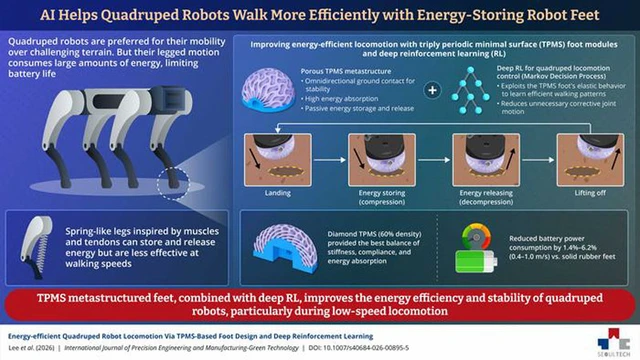
Engineers from the Seoul National University of Science and Technology have proposed a radical departure from this approach: integrating energy recovery directly into the structural material of the robot's feet. In place of cumbersome mechanical springs, they developed porous hemispheres 3D-printed from a high-elasticity polymer.
The foundation of this innovation is the concept of Triply Periodic Minimal Surfaces (TPMS). These are complex three-dimensional lattices composed of repeating pores and partitions. From a physics perspective, this architecture achieves an ideal equilibrium: it maintains minimal weight while providing controllable stiffness and the ability to efficiently absorb mechanical energy, which is then released as the limb lifts off the ground.
During the research phase, three structural types were tested: simple, gyroid, and rhombic. The rhombic lattice with a relative density of 60% yielded the best results. This specific configuration provided the optimal level of deformation and minimized internal material friction, allowing for maximum efficiency in storing impact energy.
However, implementing this innovative material was only half the battle. It became evident that simply replacing the feet was insufficient; under standard gait algorithms, the accumulated energy either dissipated or triggered parasitic oscillations in the chassis, which the electronics attempted to compensate for by increasing the load on the actuators.
To synchronize the hardware and software, the team employed Deep Reinforcement Learning (DRL). The robot's controller was trained to account for the deformation and recovery phases of the TPMS structure. The model's reward function was tuned so that servo operation aligned precisely with the moments of elastic energy accumulation and release during ground contact.
Practical trials were conducted using the RBQ-10 platform. A comparison between the new porous feet and standard solid supports demonstrated that the robot maintained full stability across all speed ranges while significantly reducing the load on the power system. Quantitatively, energy consumption decreased by 1.4–6.2% at speeds ranging from 0.4 to 1 m/s.
While such figures may seem modest in a general industrial context, for autonomous systems engaged in long-term patrolling or rescue operations, every percentage of energy saved translates directly into additional operational hours and an expanded mission radius.
 Samsung M16: A New Standard for OLED Panels