The contemporary electric vehicle market is grappling with a fundamental paradox: while consumers are driven toward full electrification, they remain tethered to inadequate infrastructure and plagued by "range anxiety." The solution to this dilemma lies in series hybrids, where the internal combustion engine is reimagined as an onboard power plant. Xiaomi enters this arena with the SkyNomad, striking an uncompromising balance between operational range and vehicle dimensions. This model demonstrates that true efficiency is defined not by raw battery capacity, but by the sophistication of energy management.
The SkyNomad N70 is built around the principle of a series hybrid architecture. In this configuration, the internal combustion engine (ICE) is entirely decoupled from the drivetrain; its sole purpose is to serve as a generator to recharge the traction battery and power the electric motors. For the Chinese market—where consumers prefer pure EV operation for daily commutes while reserving gasoline for long-haul journeys—this setup represents an ideal compromise.
Xiaomi has achieved an impressive all-electric range of 505 km. Notably, this result is powered by a 76 kWh NMC battery, which is smaller in capacity than some of its competitors. For instance, the Leapmotor D19 features an 80.3 kWh pack, yet its range remains below the 500 km mark. The SkyNomad N70’s advantage stems from superior weight management and optimized energy consumption.
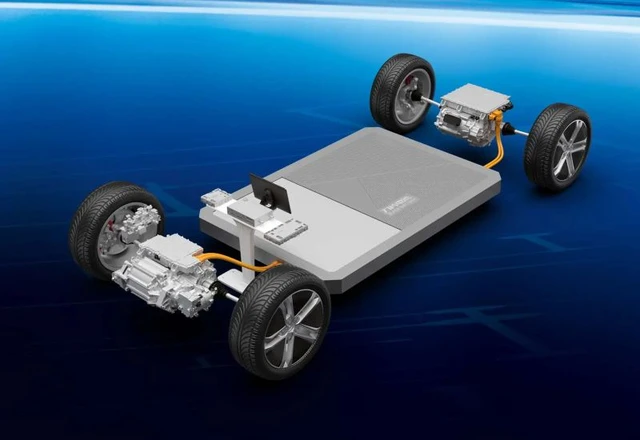
The vehicle's technological stack warrants a deeper analysis. To minimize transmission losses, engineers implemented power electronics based on silicon carbide (SiC). This material significantly reduces thermal dissipation compared to traditional silicon semiconductors. Combined with low-rolling resistance tires and a lightweight chassis, the N70 achieves an efficiency of just 15.85 kWh per 100 km.
The N70 Max powertrain utilizes dual electric motors: a front motor delivering 282 hp and a rear motor providing 134 hp, resulting in a peak combined output of 416 hp. The generator's efficiency is particularly noteworthy; the 1.5-liter ICE boasts a thermal efficiency exceeding 44%, generating approximately 4 kWh of electricity per liter of fuel.
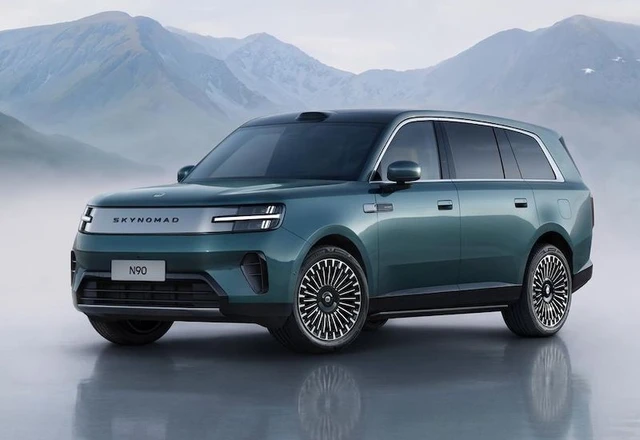
For those requiring more utility and space, the N90 Max variant is available. This full-size SUV, measuring 5,285 mm in length with a 3,080 mm wheelbase, can accommodate up to seven passengers. In the six-seat configuration, the cabin offers enhanced flexibility via adjustable second- and third-row seating. In terms of dynamics, the N90 Max mirrors its smaller sibling: it sprints from 0 to 100 km/h in 5.9 seconds with a top speed of 190 km/h.
The flagship's energy autonomy is striking: in combined mode, the vehicle can cover up to 1,705 km without stopping for fuel. With a fully depleted battery, fuel consumption remains modest at 6.26 L/100 km. Charging speeds also align with modern express standards: the battery charges from 20% to 80% in just 18 minutes, recovering roughly 285 km of range during a 15-minute stop.
The presentation concluded with a demonstration of SkyNomad's active safety systems. In a controlled experiment, the vehicle suffered simultaneous blowouts of both left-side tires while traveling at 160 km/h. The intelligent stability control system successfully compensated for the loss of traction, maintaining vehicle equilibrium and ensuring a smooth stop even under full load.
Market positioning is aggressive: the N70 Max starts at $38,410, while the flagship N90 Max begins at $44,570. While top-tier versions are already available for purchase, more affordable configurations are expected to hit the market in September.
 Solid-State Batteries are Changing the Game